One of these days I’m going to find the tape I made of my own interview with Trillin for the unpublished final issue of my book review and get a chance to verify that I sounded like a doofus in my singular chance to talk to him one-on-one.
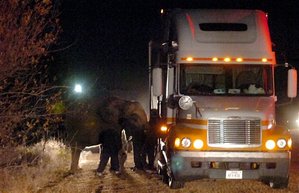
“Didn’t have time to hit the brakes. The elephant blended in with the road,” driver Bill Carpenter said Thursday. “At the very last second I said ‘elephant!'”
Elephant? “Blended in with the road”? Really? How old was this guy?
Carpenter, 68, said he swerved his SUV at the last second and ended up sideswiping the 29-year-old female elephant on U.S. 81 in Enid, about 80 miles north of Oklahoma City.
So not that old. But apparently, this was one elephant that really had a talent for camouflage:
Enid veterinarian Dr. Dwight Olson said the elephant was hiding in some bushes just off the highway when he arrived shortly after the accident. Handlers from the circus were able to calm it down, and Olson cleaned the leg wound and gave it some pain killer.
Dr. Olson said the elephant escaped major injury.
The unnamed elephant’s powers to cloud the mind extended even beyond its immediate surroundings:
A booking agent for the circus, Rachael Bellman, said she was unaware the incident, and a telephone message left with circus officials wasn’t immediately returned.
Your client’s elephant escapes, and gets hit by an SUV? Yeah, I wouldn’t admit to knowing anything about it either.
We’ve opened up night schools to educate the adult illiterate. We have paved the highways. … We have built a new capitol. We have taken the insane out of the jail cells and placed them in modern institutions. We have eliminated barbarism. … And now, the corporate element of this state … who profited by, who ransacked this state … are being told what they can do, what they can’t do, what they will pay, what they can’t keep from paying for the welfare of the people of Louisiana and we expect to have this state ruled by the people and not by the lords and the interests of high finance.
It was almost exactly seventeen years ago that the first issue of Plant’s Review of Books appeared, just before the 1992 presidential election. Apart from publishing and editing the review, my major contribution to that issue was one of a pair of articles on political biographies I titled “Back By Populist Demand”. One was the then-new Truman by David McCullough. My review was of T. Harry Williams’s 1972 Pulitzer Prize-winning biography Huey Long (which had been my father’s until I kifed it from his shelf), which has moved down a few positions over the years but is still the fifteenth item in a Google search of “huey long”.
Long, of course, was the Senator (and former Governor) from Louisiana who came to power in the state before the Depression but who made his name as a populist anti-corporate crusader. Needless to say, he was also labeled an American fascist (and/or communist), a demagogue, and the most dangerous threat to democracy in the United States before he was assassinated in the capitol building in Baton Rouge in September 1935. Regular readers know I post his Share Our Wealth economic plan as a tribute on the anniversary of his death; Florida Representative Alan Grayson invoked him on Bill Maher’s show last month: “You gotta put some jam on the bottom shelf where the little man can reach it”. My review was written during the recession that cost George H.W. Bush his chance at a second term; I ended with these words: “Populist campaigns are a barometer of how difficult the times are, and if you think things are bad now, wait until you hear a politician comparing himself (or herself) to Huey Long.”
This segment of Williams’s biography (pp. 561-563) is from the spring of 1932, when Long proposed a Share Our Wealth resolution and clashed with Sen. Joseph Taylor Robinson of Arkansas — leader of the Democrats in the Senate from 1923 to 1937, vice presidential candidate in 1928, and majority leader from 1933 on. The debate sounds so familiar, despite being more than 75 years old.
The Democrats had a majority in the House and with the progressives controlled the Senate, he [Long] said, and this might be their last chance to do something to redistribute wealth, for the Republicans could well win in the November election. “All we can do is to get what we have now,” he cried. But the Democratic leadership, dominated by the same big banking interests that ruled the Republicans, was afraid to offend the rich. … He threatened that if the Democrats nominated a presidential candidate advocating the ideas of Robinson, he would vote for a Farmer-Labor candidate or a Republican candidate, if either of them stood for cutting down swollen fortunes “as God Almighty demanded and ordained.” Then came his clincher, his formal repudiation of Robinson’s leadership: “I send to the desk, Mr. President, my resignation from every committee…that has been given to me by the Democratic leadershup since I have been here.”
…
He [Long] exhibited to his colleagues a cartoon in color on the front page [of the Chicago Tribune] depicting Robinson carrying an American flag and Huey Long, “new Senate radical,” carrying a red flag. Affecting a tone of injured indignation, he complained that the cartoon did not do justice to his friend, the great minority leader. For one thing, it did not show any stars on the flag he was bearing.
But, Huey announced dramatically, he would supply the stars himself, forty-three of them, stars that should be in a flag carried by Joe Robinson. He then produced the legal directory of Little Rock, Robinson’s home town, and read off the names of the clients of Robinson’s law firm, forty-three corporations—oil, utility, and chain-store companies—some of them among the largest corporations in the South and the country. If he accepted the leadership of Robinson, he cried, he would be following the lead of a corporation attorney. “It may, Mr. President, be communism for me not to accept that as being a proper sphere and location for my activities,” he said sarcastically. He had never bowed to the will of the corporations, he shouted, and he was not going to bow to these interests in the Senate of the United States. If the leadership wanted to discipline him, let them try it. “The only way they can read me out of the Democratic party is to beat me down in the state of Louisiana,” he roared, “and that has been tried one or two times and can be tried again whenever they see fit.”
Abruptly dropping Robinson as though disdaining to give him any more attention, he charged that the Democratic and Republican parties were both controlled by two big New York bankers. Bernard M. Baruch was running the Democrats, even though he was “the twin-bed mate of Hooverism,” and Eugene Meyer, recently appointed to head the Reconstruction Finance Corporation, was running the Republicans. Thus Hooverism controlled the Senate, “spouting through the two foghorns, Baruch on the one hand and Meyer on the other, Robinson on the left and somebody else on the right.” Why, he said, the Republicans and Democrats reminded him of the patent medicines he had known in his salesman days: there was no more difference between them than between “high popalorum” and “low popahirum.”
At one stage in his remarks Huey was forced to take his seat when a senator complained that he was violating the rule not to reflect on another member: he was implying that Robinson’s corporate connection had influenced his votes. Allowed to continue but cautioned to observe the rule, he jumped up and said impudently: “I want now to disclaim that I have the slightest motive of saying, or that in my heart I believe, that any man could to the slightest degree be influenced in any vote which he casts in this body by the fact that association might mean hundreds of thousands and millions of dollars in the way of lucrative fees.” The Senate could not restrain an appreciative laugh.
Robinson had not been present when Huey began his speech. He came in later and sat by his desk, his face red with anger. But he made no attempt to reply. Significantly, no Democratic senator rose to defend him. The Democratic liberals were delighted with Huey’s attack. None of them had known of Robinson’s corporate clients because none of them had taken the trouble to dig up the facts. The Democratic conservatives, in an election year, hesitated to range themselves on the side of a man who had been exposed as a corporation attorney. The only senator who tried to defend Robinson was a Republican, David A. Reed of Pennsylvania, one of the most conservative members of the body.
…
Huey’s votes on other amendments to the revenue bill should have interested those commentators who had pegged him as a radical. Senators from various states offered amendments raising the tariff duties on various products coming into the country from abroad—oil and lumber, which were Louisiana products, and coal and copper. Huey voted for every increase and spoke at length in support of a pro-tariff policy. When other Democrats protested that high tariffs were contrary to Democratic tradition, he read from the record to demonstrate that the protesters had in the past voted to increase the duties on products produced in their own states. Walter George of Georgia cried angrily that the senator from Louisiana was “utterly lacking in the sensibilities which usually characterized the intercourse between men in this body.” Another senator, Millard Tydings of Maryland, said that Long had no concept of how courtesy was defined.
We were walking past the River Park Square in downtown Spokane this evening and through the windows was a throng of children watching other kids just inside the windows, many of whom were wearing fairy wings and other kinds of costumes in some sort of ceremony. It was packed enough that we decided our entry through the doors on either side of the ceremony would only be distracting; rather than walk through the mall we went around, so we didn’t figure out exactly what was going on.
In one of those completely odd juxtapositions of circumstance, the speakers on the outside of the mall were blasting Arthur Brown’s classic “Fire.”
By chance I happened to check in on Erica (The iPhone Developer’s Cookbook) Sadun’s iPhone SDK Google Group yesterday when she was trolling for someone with “modest success or struggles” to round out an online chat about iPhone development and the App Store. I don’t check in on the list every day, but I made a silly remark about having lost the struggle and Erica wrote back to invite me onto the panel.
Sometimes I think that I’m overblown in my own self-promotion — although the sales and downloads of Bedeviled might point that I haven’t actually been doing enough — but I certainly missed this opportunity, because I didn’t even think of mentioning the chat anywhere until the hour was almost over.
Anyway, if you’re interested in hearing what several successful developers (and me!) had to say about the current state of iPhone development, you can find the archive through TUAW: The Unofficial Apple Weblog.
I wasn’t able to go to the MAX show this year — again — but as I mentioned the other day I was making a recorded appearance there via Phillip Kerman’s burgeoning video sarcasm business. Adobe hired him to produce some pieces, including the segue from the MAX Awards to the Sneak Peeks session (part of which was captured in a series of photos by Kendall Whitehouse on Flickr).
I knew this was going to be the case, but it wasn’t until I was flicking through Kendall’s photos that it was really driven home: My voice-over for Phillip’s video was coming out of the speakers on the LA Convention Center stage right after Mark “Luke Skywalker” Hamill had been up there, and I absolutely, completely missed it.
[UPDATE] This is what happens when you only get reports second-hand. Phillip’s piece (and my voice!) weren’t played after Mark Hamill was done. The end of this video shows Hamill and Adobe’s Ted Patrick still on the stage in front of the opening screen of the video, as the lights go down after Patrick introduces the “prepared legal statement.”