What Can You Say About a Seven-Year-Old Printer That Died?

I bought my first color laser printer back in October 2003 to replace a monochrome Texas Instruments machine that had printed thousands of pages of code and documentation for me since 1991. The TI was compact, even for that long-ago time (though it had nothing on the Diconix), and cost something like $1,200 dollars.

My printing needs had grown more sophisticated by 2003 (so I thought) and while I’d been sharing a large-format Epson ink-jet printer for color work with one of my office partners on Hawthorne Blvd. there was no way to shoehorn both my computers, office stuff, and two printers into my home office when I scaled back after the pulmonary embolism that followed my broken leg (not to mention a radical slowdown in the amount of work coming my way since the tech bubble burst). The Minolta-QMS 2350 that replaced it was a comparative monster — though far smaller than the first color laser printers I’d encountered a decade earlier — and seemed incredibly fast. It cost about $1,400 because I got the optional duplexer unit for it (ASSIGNMENT: Calculate the cost savings on paper factor against the price of the duplexer unit).

A couple of months ago it started jamming — initiall on the first page after startup and then on everything — and though I’d just replaced the OPC drum (whatever that is) and ordered a new black toner cartridge (which I couldn’t install because suddenly the color cartridges stopped rotating) it looked like the fuser unit was dead and even that may not have been the end of my problems. So, though it wasn’t exactly in the budget this month, new printer.

So the new unit was picked up last night and installed this morning. It seems to be doing what it’s supposed to (although I have to try printing from the Windows side of things yet). It prints PostScript 3 like the old unit did. It has Ethernet like the old unit. It’s probably two-thirds the volume of the 2350. It’s got a built-in duplexer. It cost me just under $400, which is what the magicolor’s duplexer cost.

Not-So-Happy Columbus Day!

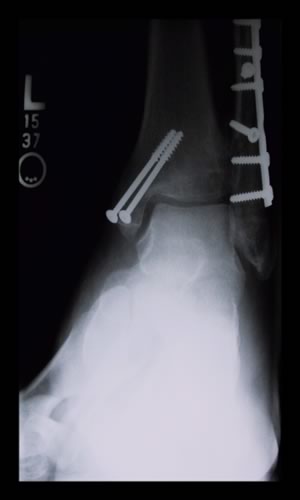
To atone to the natives of North America in some small part for this day on which we remember the first steps of some European (not the first) onto the shores of one of the many islands in the Caribbean (which one we don’t really know for sure) I offer this, an x-ray of my ankle broken eight years ago today while putting some gutters up on my garage. It is a small penance, I know, but the same leg has since nearly killed me with blood clots, had a table saw dropped on the knee, and been slashed by a guy wire.


An ankle, broken with screws

The Check Is in the Mail—Er, Bank

I went to balance my business checking account yesterday and saw that there was a $30 deposit on the last day of September that I certainly didn’t remember. A quick check into its origins showed that it was from Apple, of all places. And by signing into my iPhone developer account I was able to determine that it was, indeed, a disbursement from sales of Bedeviled, which has been out now for fifteen months (as of Sunday).

So I’ve finally made some money off the iPhone boom. Thanks to those of my friends and colleagues who bought a copy! Only a couple thousand dollars more and I’ll have broken even on the new computer, the copy of Unity, the iOS devices, the books and other stuff that made it possible!

To the Top!


I am a human rocket
On a mission of deployment
I’ve been cocked and loaded
Ready for the culmination
I am a human missile
Guided by a secret agenda that commands my every thought and deed
And wills me on my way

I am a human rocket
On a mission of redemption
I’ve been cocked and loaded, primed by everything I know
I am a human missile
Guided by a secret voice that commands my every action
And wills me on my way

There is no turning back, there are no second thoughts
First things first and all things fair, be it love or war, they say
There is no plan named B on the land in the air or on the sea
That is what’s supposed to be
My duty now awaits me

I am a human rocket
On a mission of instruction
I’ve been primed and programmed since the beginning of time
I am a human missile
Guided by a secret master
That commands my every motion
And wills me on my way

I’ve found my target,
I’ve reached my co-ordinates
I’m set to detonate and resonate
The final poem I will create
I’ve made a video
It tells a story, oh….
I guess it’s time to go
Don’t forget to rewind!

I am a human rocket
On a mission of destruction
I’ve been locked and loaded
And ready for the confirmation
I am a human missile
Guided by a secret perfection that commands my full conviction
And wills me on my way

Large parts of the experience will go by unnoticed
We are all distracted by the lights and sounds of everything and nothing
Did you remember the breath you took when I let you off the hook?
And sent you swimming away back into your cell?

I am a human rocket
On a mission of reduction
I’ve been cocked and loaded
Since the dawn of time
I am a human missile
Guided by a secret voice that commands my every thought and deed
And wills me on my righteous way

—Devo, “Human Rocket”, Something for Everybody

75 Years

Five years ago, in the immediate aftermath of the flooding of New Orleans due to the failure of the seawalls built by the Army Corps of Engineers, I republished a piece I wrote in 1992 for my book review magazine on the Pulitzer Prize-winning biography Huey Long by T. Harry Williams. That was on the 70th anniversary of the day Sen. Long was fatally shot in the Louisiana capitol building in Baton Rouge.

Today marked the 75th anniversary of that assassination. In the past five years, Louisiana and much of the rest of the Gulf Coast have struggled to cope with the effects of Hurricane Katrina. New Orleans in particular has been irrevocably changed by the flooding of the city and the subsequent exodus of residents, many of whom have been unable to return. Then, of course, this year there was the Deepwater Horizon disaster, the true effects of which we aren’t likely to know for some time.

Huey Long came into national prominence in the hard times of the Depression. He’s thought of today mostly as a demagogue or a proto-fascist who appealed to the basest populist instincts of the masses, but Long’s was one of the first voices in government to be raised against companies like Standard Oil which he viewed as stripping the people of his state of their mineral and resource wealth and giving virtually nothing in return. And that was his view before the Depression hit.

Long’s “Share Our Wealth” plan was a means for reducing income inequality that put restrictions on inherited wealth and income that were far more radical than anything proposed by anyone in politics today, much less an elected United States Senator.

And here we are in the Great Recession. Three-quarters of a century on from the day the Kingfish was gunned down (he didn’t die for two days) and the problems he fought against have only ossified. Nobody in the Democratic Party is fighting corporatism (and forget about the Republicans). Reducing income inequality isn’t even on the radar screen; we’ll be lucky if we don’t get an extension of the Bush tax cuts for the rich that increased it over the past decade.

I don’t know how to end this post other than with this.

The Surge

It’s been a very quiet month here at darrelplant.com. I know. I haven’t really had a lot to say on politics except in reaction to things, and I usually leave those in comments at other sites and blogs. I fire up Twitter only every couple of days, mostly just to see what other people are up to, although I did have a brief exchange with iPhone author @jeff_lamarche the other day about 1970s editions of Dungeons & Dragons boxed sets. And I’ve been checking in on Facebook to keep in touch with Director-Xtra-developer-turned-poker-pro Tomer Berda as he’s been playing in the European Poker Tour events in Estonia and Portugal this month.

But the main reason the blog’s been so quiet is that all of a sudden I have a handful of projects. Not just any projects but Director projects. And just to crank the bizarre to 11, they’re Director 8.5 projects. Technically, I guess that would be cranking the bizarre back from 11 (or 11.5). I’ve even had to buy a couple of Xtras (from Tomer, natch) for the first time in seven years.

I’m not chalking this up to some resurgence in Director, but the work is certainly welcome after several years of drought.

The Internet Did It

The Huffington Post featured a piece yesterday consisting of short essays on the future of literary reviews in the world of the internet by the editors of journals ranging from Agni to The Yale Review. I guess that’s an important topic now that the web’s been around for more than fifteen years. Always good to mull these things over.

For my own part, of course, I’m proud to say that the internet had nothing to do with the demise of my own review. Plant’s Review of Books was able to collapse entirely without me saying “The computers did it!” or “Nobody reads any more!” 100% human failure. I take the rap.

Bimbo Eruption

Grupo Bimbo Logo

Food 4 Less still has the durian fruit in their produce section. While Barbara and I were shopping there today I noticed another less exotic though still amusing import.

When we were in Mexico a couple of years back, I saw the Bimbo bakeries logo everywhere on signs, trucks, and shops. We got a bit of a chuckle remembering Barbara’s research a couple decades back to demolish an opposing attorney’s argument claiming that “bimbo” wasn’t really a derogatory term. I guess it’s a good thing he hadn’t spent much time in Spain or Mexico or he’d have claimed it just meant “bread”.

We wondered at the time how the brand would fare in the US, little knowing that Bimbo was already the corporate owner of well-known US brands like Orowheat, Entenmann’s, and Boboli. And now you can get your Bimbo bread here in Portland.

Behold the Catsino

Darrel's Mutant Catsino

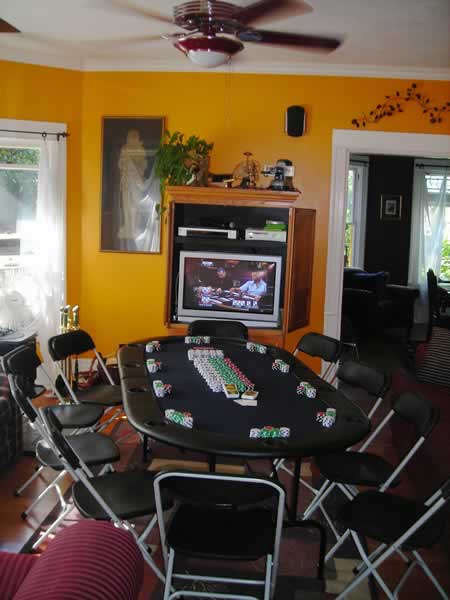
Last week was the first time I’d ever hosted the bi-weekly poker game that I’ve been playing in for a couple of years, so I had to set everything up to make sure that at least one table could be shoehorned into the space I was planning to use. As you can see, our living room doesn’t have the typical poker mancave ambience of someone’s basement/garage/unused bedroom.

The “Catsino” is not only bright and airy, but it’s got a couch, a loveseat, and a cushy chair like “The Grand” room at the Golden Nugget Casino where Poker After Dark is filmed (although there’s a bit less clearance between the back of the player’s chairs and the cushions). The stuff on top of the TV includes the Ganesh statue I bought for our nineteenth anniversary.

You can probably guess from the fact that I took a picture I was pretty pleased with the setup. I arranged 20 buy-ins and add-ons worth of chips and a bunch of extras on the table, put an ace of diamonds and four of clubs on the table to honor Tomer Berda’s World Series of Poker bracelet win (using one of the “official” WSOP decks I bought in Vegas when I flew down to have lunch with him, and which are not standard-size poker cards), and fortuitously found a clip from Poker After Dark to put on the TV showing Phil Ivey about to lose a bunch of money with a set of fours to David “Viffer” Peat who’s drawn a flush with my favorite hand: a suited ace and jack.