I’ve gotta stop faking it
I’ve gotta start facing it
I’m gonna take my final bow
Then I’m gonna take my place in the crowd
I know I’ll get used to it
I’ve gotta stop acting like a clownI’ve gotta start facing up to what I really am
I’ve got to realize I’m just an ordinary man
I think that I’ll just settle down
And take my place in the crowd
I don’t want to lie to myself any moreAm I just a face in the crowd? Is that all I’ll ever be?
I don’t want to be anything that isn’t really me
Mister can you tell me who I am?
Do you think I stand out?
Or am I just a face in the crowd?
—The Kinks, “Face In the Crowd”, Picture Book (compilation)
Bedeviled by Bedeviled
It was two years ago today on a Friday before a holiday weekend just after a major iOS release that I made my splash on the iPhone app scene with Bedeviled: The Most Diabolical Sliding Puzzle Ever. A splash, followed by a quick sink to the bottom and my usual discouragement with new ventures that don’t pan out.
Gandhi Would Approve
Making the most of the Supreme Court striking down California’s ban on the sale of violent video games to minors, one of the proponents of the ban picks the right metaphor to show how the message of peace wins even with the reversal:
“I think we definitely hit the industry over the head with a 2-by-4,” said James Steyer, CEO of Common Sense Media, a leading kids and media organization in the United States.
Justified
According to a White House response sent to Congress about the rationale that the US is not engaged in a war with Libya and is therefore unhindered by any legislative restrictions placed on it by the 1973 War Powers Resolution:
U.S. operations do not involve sustained fighting or active exchanges of fire with hostile forces, nor do they involve the presence of U.S. ground troops, U.S. casualties or a serious threat thereof, or any significant chance of escalation into a conflict characterized by those factors…
The same could be said about a US nuclear strike on any country unable to mount a similar response. Just planning ahead.
If You Think Poker’s Risky, Try Writing Computer Books
Yesterday was the tenth anniversary of the publication of Special Edition Using Macromedia Flash 5, the book that put a cap in the eye of my career as an author of multimedia programming texts.
I’d gotten off to a bang with my Shockwave book six years earlier. It was the only book that I feel was an actual success (for me, if not for the publisher). It was supposed to be followed by a sequel that followed up on the improvements in Shockwave over the next eighteen months, but that was cancelled and my approach to a dictionary of Shockwave Lingo terms in that book turned into The Lingo Programmers Reference—probably the single most-well-received work I ever did—but which had the bad timing to hit the streets about the time the publisher was being consolidated into a new company. The birth of that monster book was difficult, I had to delve into Lingo I’d never used and try to figure out what it actually did. It went over schedule, the computer book publishers were already tightening up advances due to a glut of material, so what I was paid before publication was a lot less than I had on the Shockwave book and I never saw any royalties after publication.
My literary agent proffered me the chance to write the first official book on Flash, from Macromedia Press (he was representing them). It was a flat fee, no royalties were to be paid, it was the hot new technology. Macromedia had just bought Flash, and it was more of a design and animation tool than a programming platform at the time, so I wasn’t exactly the person you’d think of to write it, but I needed money after months of working on LPR for no return. But I found the Flash book demoralizing. I’m not a designer or an animator—at least not in any sense that really counts—and the samples I was producing looked like crap compared to the material out in the wild. Still the book probably sold more copies than anything else I ever did combined. Not that I was to see any of it. The publisher left my name on the Flash 3 version of the book but didn’t hire me to make the changes.
I worked on portions of a few other books, but the Flash 5 book was the last one I wrote more than a third of. It was supposed to be me and my office partner Peter Sylwester, with Pete handling the graphics and animation side of things and me doing programming, which had improved substantially over three years, but for various reason Pete had to leave the project and the publisher brought in Robert Cleveland to write the first half of the book. So far as I remember, I never met or even corresponded with Robert, or saw any of his material before the book shipped.
Every month for the past ten years, I’ve gotten a royalty statement from the publishing company’s parent. According to the most recent, the “Total Net Earnings Current Period” is -$658.70. That’s after ten years. The most recent statement month earned ninety-four cents. It was -$705.47 in January 2009. Just another data point in a graph of…something.
But Is He Elect-Abel?
What is it with the GOP that the guy who was their nominee for President last time around and the guy who may have won the first debate in this year’s contest have surnames referencing the Biblical First Murderer?
John McCain’s last name references, at least, the “son of Cain”, but Herman Cain comes from a family just outright named for Adam and Eve’s more bloodthirsty son. Sins of the fathers and all that but you’d think it would bother the more religious of the party base. Do they have to get a campaign line with the prefix “666” or something?

Forty-Two
It was ten years ago today that Douglas Adams died. Adams was just a couple of months past his 49th birthday, and I’m coming close to the half-year mark, so I guess I’ve outlived him, but then there’s the whole quality v. quantity debate.
I was working in a sci-fi bookstore when pirate cassettes of the original BBC Radio version of The Hitchhiker’s Guide to the Galaxy hit American shores. Dupes were eagerly passed around among nerds and geeks; I’ve probably got mine in a box somewhere still. I remember being astounded that there was still radio work being done, it certainly wasn’t something you found on US stations.
I didn’t follow Adams’s career through it’s entire arc—I got off the sci-fi-mode, then out of books—but I remained aware of his impressive body of work, and the love of the fans.
So long and thanks for all the entertainment.
Digitized Decade 11: You Can Check Out But You Can Never Leave

I noticed it on one of our very first ambles in Amsterdam, because it was literally on our way from the train station to the hotel we stayed at. If I’d known about it beforehand, I would have had to make reservations there, simply because of the name. Ten years have gone by and I still don’t know anything about this little hotel on Prins Hendrikkade other than I really like the sign.
This trip was, by the way, the first place we ever saw a smart car. It took me seven years to get one.
The Digitized Decade is a look back at the first year of my entry into consumer digital photography.
Digitized Decade 10: Those Who Can, Do; Netherlands Edition
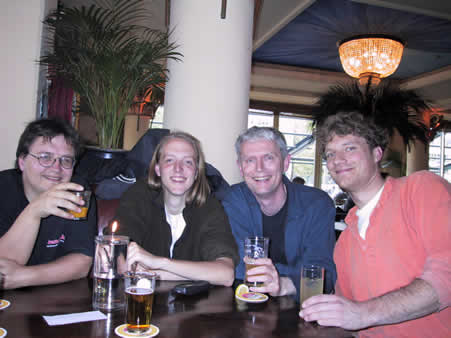
One thing that was astounding to me about writing books on Director is how outsized my credentials appeared. In mid-1995 when I started working as a freelance digital file manipulator, I had never worked professionally in Director, although I’d been messing around with it for a couple of years and had actively been looking for projects. I lucked into a job actually teaching Director at Portland State University by being in the right place at the right time and proving that I knew enough to teach an introductory course. Then I chanced into the Shockwave book at the end of the year and I had a little bit of celebrity in the small Director pond. But it wasn’t based on any actual work I’d done, and as time went on and I did more writing gigs and continued teaching, I couldn’t really share stories about the cool kiosk or online gig I’d had because they just didn’t exist. I wasn’t exactly a fraud because I never represented myself as anything other than a writer and demonstrator of techniques, but there were times when I sure felt out-classed by the people I was hanging out with.
What was worse was that people were always eager to see me. I’d met up with developers on a London trip shortly after the publication of my first book, hung out with the infamous Peter “Lingo Sorcery” Small at his home, and visited James Newton, as I’ve already mentioned. Amsterdam was the superlative of these visits, because people actually travelled for significant periods of time (about as long as you can travel in the Netherlands) to get together at a cafe and drink some beers. From left to right in the photo above: Mark Reijnders (whose iPhone app “Clean My Screen” is currently available); Lucas Meijer (the 3D guru I’d met at UCON 2001 just a couple months earlier, now working for Unity); Mark Hagers (still doing the digital media thing); and Pim van Bochoven (Mr. OSControl Xtra who is always doing incredibly cool things). I knew why I wanted to meet them but why the hell did they want to meet me?
The Digitized Decade is a look back at the first year of my entry into consumer digital photography.
Digitized Decade 9: Fast Flying Ferries
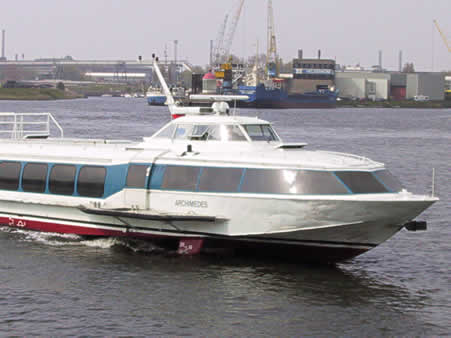
If there’s one thing I regularly do on trips it’s to get out on the water. Maybe it’s one of the corny DUKW amphibious landing craft tours of Boston, or it’s a whale-watching trip in Hawaii, or even the jet boat rides here at home on the Willamette River, but I love cruising through a town by boat. Amsterdam, of course, offers an array of water-related transport options, but when I saw that there were Russian-built Voshkod hydrofoils cruising between Amsterdam and IJmuiden-Velsen it didn’t matter at all that I had no idea where IJmuiden-Velsen was (it’s on the North Sea coast).
Barbara and I had been on a hydrofoil before, for the long ride from Seattle to Victoria, but the opportunity was too good to pass up. Half an hour out, half an hour back, along a heavily-industrialized canal, with IJmuiden-Velsen at the other end! We got out there with no real plan or idea of what we could do, managed to order some fries and wonderful curry ketchup at a stand (passed on the herring) at the dock, and headed back with another a tick off my checklist ten years ago today.
Call us troglodytes, we did not visit the Rijksmuseum. If you look at the prow of the Archimedes (now, apparently, retired from service) you’ll see a bunch of dents. I guess zooming through trafficed canals at 40mph can lead to problems.
The Digitized Decade is a look back at the first year of my entry into consumer digital photography.