Wasting Time

What I should be doing with my time instead of reading my email and blogging (assuming I had any real talent):

Sep 19, 2008, 01:34 AM

Trism developer Steve Demeter revealed at a conference that he had generated $250,000 in income from his popular iPhone game since its launch on July 11th.

Certifiable

I just got my certificate acknowledging that I’m an Adobe Certified Instructor in Director 11.

I haven’t even got any reason to upgrade to Director 11. I doubt anyone’s going to be asking me to teach it.

Oh, and it’s dated August 11, 2006. Talk about slipping release dates.

Generic

Nathan pointed out to me that the new Director 11 product feature page has a line about the “ever-expanding ecosystem of third-party Xtras” available (although it’s hidden beneath the “Endless opportunities” expandable heading). That’s a bit of a stretch for 2008.

What I noticed is that the web team at Adobe went the extra mile in customizing the page for their beloved crazy aunt in the attic, leaving the generic “Product Name” in the template for the page header.

Director 11 Features page

Oh, well. I hope everyone’s having a good time at GDC. Wish I was there.

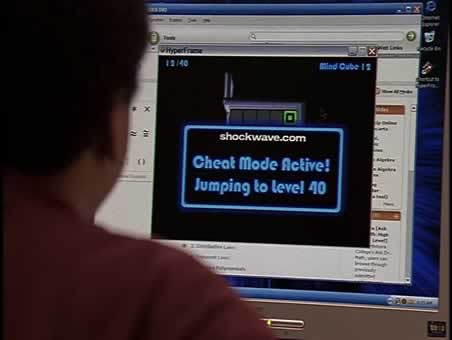
Cheat Mode Active!

Someone finally returned the second disk in the fourth season of The Wire to Netflix, so I could go ahead and watch the third and fourth disks that I’d jumped ahead of the waitlisted disk (I have to invent a term for that technique). Then, in the middle of a little mini-marathon of episodes (specifically, “Corner Boys”), there’s this reference to some long-ago thing in my past.

Ripped From the Headlines

A project I worked on a few years back was the Mac port of a Director-based CSI: Crime Scene Investigation CD-ROM game. It was clean and safe. But via Rick Perlstein at the Campaign for America’s Future, another CSI product appears to be not so healthy (and no, it’s not the Kiddie Autopsy Kit):

December 4, 2007

Tom DeLuca/Al Kaufman

Toys “R” Us, Inc. Headquarters

One Geoffrey Way

Wayne, NJ 07480-2030

Attn Mr. DeLuca/Mr. Kaufman:

We are writing to ask that you immediately remove from sale all Planet Toys’ CSI: Crime Scene Investigation™ Fingerprint Examination Kits due to recent test results finding dangerous levels of asbestos in powders contained in some sample kits.

The type of asbestos detected in these kits, tremolite, is one the most lethal forms of asbestos, and is the same deadly asbestos fiber contained in products made from ore mined at the notorious W.R. Grace mine in Libby, Montana. Tremolite asbestos, like that found in the CSI: Crime Scene Investigation™ Fingerprint Examination Kits, has killed scores of people in Libby, many who never worked in the mine itself.

What is particularly troubling about this toy is that children are directed to blow the asbestos contaminated powder after dusting for fingerprints, which would make it much more likely that children playing with this toy would actually inhale potentially lethal asbestos fibers. Any amount of this fiber in a children’s toy, particularly in a powder that is certain to be inhaled, is completely unacceptable and unnecessary. A single exposure to tremolite is sufficient to cause fatal mesothelioma or lung cancer later in life.

CD-ROM CSI game? Non-lethal. Asbestos-laced fingerprint kit? Maybe not.

I see this as a great opportunity for CSI, quite frankly. Once the writers’ strike is over, the first show ought to be an investigation into the mysterious death of a child who received a home fingerprint kit for Christmas.

Just a Niblz

Niblz.com founders Nathan Pryor and David Shireman (photo from Vancouver Business Journal's Megan Patrick)I’ve mentioned my former co-worker and fellow Director programmer Nathan Pryor before because he’s a bright guy with a good sense of humor and a hell of a sense of fashion (that’s him on the left in the photo).

Nathan and a two-jobs-back co-worker (can’t this guy settle down?) were featured on the front page of the Vancouver Business Journal today for a Web tool they sort of publicly launched on April Fool’s day this year called Niblz.com.

Vancouver natives Nathan Pryor and David Shireman were tired of spending precious lunchtime minutes trying to decide where to dine. Trying to coordinate several peoples’ tastes and schedules was tiresome and downright boring.

The friends met in 2000 working at Vancouver-based HOSTS Learning Corp., and to solve their near-daily dilemma, Pryor developed a simple, web-based program to do the work for them.

“We thought, ‘Couldn’t we have someone just decide for us?'” Shireman said. “The Internet does everything else for you.”

The site, which they’ve since refined and made available to public at NIBLZ.com, allows one user to invite friends out to eat electronically.

The user chooses several local restaurants from a database, sets a date and time, then the site emails selected lunch pals, who vote on where they’d like to dine.

The event planner also gets a vote, and when voting closes, the site tallies the votes and emails each attendee the “winning” restaurant.

Read all about it.

My own front page appearance in the Portland Business Journal was so long ago that it’s not even online. Ahhh, to be young again.

Nathan holds himself

The White Zone Is For Loading XML

A question on DIRECT-L about sending a command from ActionScript to Lingo using a URL beginning with the string "lingo:" made me think that perhaps a post about the interrelationship between Flash and Director might be useful, since I hadn’t done anything on the subject for a while.

The question involved trying to trigger a Lingo handler with the XML.sendAndLoad in order to load data into a Flash sprite from the host Director movie. The intention was to get XML content and specify a destination for the data within the Flash movie in one operation, I assume.

The thing that’s important to understand here is that the ActionScript getURL function that supports the "lingo:" and "event:" functionality doesn’t actually tell Flash to do anything, it’s a command that passes data to the Flash movie container, whether that’s Director or a Web browser.

When you execute a getURL with a string beginning "http://" in a movie embedded in a Web page, the message goes to the browser and the browser loads a page. Flash does nothing with the command.

Likewise, when you use getURL in a Flash sprite in Director, it’s passed directly to the Flash Asset Xtra, which is then in charge of doing something with the string data. The movie itself is finished with the command.

The loading commands (for MovieClips, XML, etc.) on the other hand are completely internal to Flash. They actually return data to Flash and therefore do not send a message to the container application.

It’s not incredibly difficult to get XML-formatted data from Director into Flash — the last several applications I’ve worked on read faux-Unicode (you don’t want to know how screwy that is) Japanese XML files from the hard drive for manipulation in Director and display in Flash — but the only conduit for passing messages through from ActionScript to Lingo is that getURL command.

Happy Birthday, Hopper-ex

I was laid off from what I called “the last Director job in the Portland area” last week. Not that there aren’t people working in Director in Portland (there’s still a Director programmer at my old office), but I don’t expect to see any advertisements for Director programmers in the metro area in the near future.

Coincidentally, today — my last day on the Director job — is the tenth anniversary of the inception of Director’s worst-kept secret: hopper-ex.

In the spring of 1997, the Director 6 beta (codename: Hopper) had finished and boxes were shipping out. The listserv for the beta testers (hopper-l) was about to be shut down. Several people on the beta test group wondered if Macromedia might keep the list running, as it had provided a unique chance to interact with the Director team, from management to the engineers, away from the incredible noise (as hard to imagine as it might be nowdays) of DIRECT-L. The powers that be declined, but I had a Mac web and mail server in my office and some rudimentary listserv software, and in a few minutes I had created hopper-ex and invited everyone on the list to join, if they wanted.

I was able to move fast because I’d already been contemplating creating a list for Director book authors. At the time, I’d been working on The Lingo Programmers Reference, and I had a lot of questions about commands I hadn’t used that I didn’t really want to ask in a public forum, for fear of looking like a complete doofus. At least not until the book came out. So I was ready.

At first, I thought the list should only be for authors, Macromedians, and ex-beta testers, but within a few days I made two promises to myself: I wouldn’t give out the names of the people on the list and I wouldn’t restrict the list in any way. I told people to feel free to invite anyone they wanted to to join but asked that they only invite people they felt would add something worthwhile to the mix. Each successive beta has brought new people, and others have joined in periodically, but the number of subscribers has been stable at about 200 for a long time.

I’ve asked people to pull links to the signup page and references to the list in books without any fuss. While there have been clashes of personalities and a few people who’ve signed off in disgust, the self-policing “don’t shit where you eat” philosophy has worked remarkably well for a decade.

I’m not going to invite everyone who reads this to join hopper-ex. The secret that was never really a secret has been referenced on the Web for nearly as long as the list has been in existence. But I’m taking this opportunity to let people know that the list is out there. It’s not a great list, it’s not a huge list, but it’s a part of my Director history that I’m proud of. And if you know someone who’s been a Director developer for a while and you’re interested in dipping your toes into the hopper, ask them if they’re on hopper-ex and if they’ll give you the login address.

As for myself, I’ll probably keep an ear to the ground while I’m freelancing again, but I suspect I’ve done my last Director contract. Unless you count a project I’m looking at that’s converting an ancient Director application to Flash CS3. Fortunately, I’ve got a Mac capable of running every version of Director since 4 and they’re all installed!