Got Durian?

Durian for sale in SE Portland

The next time someone tells me that Portland’s OK but it’s not very cosmopolitan, or raves that their former home had a wider variety of “ethnic” food and restaurants, I think I’m going to force them into the Food4Less at SE 82nd & Powell where I took this shot of some durian fruit in the produce section.

“Pig-shit, turpentine and onions, garnished with a gym sock” is how travel writer Richard Sterling described the smell. Even the uncut fruits smell so bad they’re banned from public transport in notoriously rigid Singapore (where the sign gives them equal standing with smoking, eating and drinking, and flammamable goods), although I have to admit I didn’t smell them from a few feet away in the Food4Less.

The part I liked best about it was that the sign in the store notes that they’re eleven cents cheaper there than “SUPERMARKET PRICE”. And I have to ask exactly which supermarket they’re thinking of. They’re sure not at Fred Meyer’s or Safeway.

NPR Stuff

Joey Ramone’s brother Mickey Leigh has a book out (I Slept with Joey Ramone) that I want to read. I have to laugh at the caption informing visitors to the NPR review that in the picture accompanying the piece: “Joey Ramone is second from left.”

I haven’t seen Iggy Pop for a couple of years, but he’s interviewed here. As my friends grow tired of hearing, he touched me once.

And on a non-music note, who in the hell at NPR decided David “Cornel West is a black airhead” Horowitz was the proper contrarian voice to add to the acknowledgement of the death of historian Howard Zinn?

Maybe I Should Be the One Editing a Sci-Fi Web Site

From the AP:

Some see racist theme in alien adventure ‘Avatar’

Annalee Newitz, editor-in-chief of the sci-fi Web site io9.com , likened “Avatar” to the recent film “District 9,” in which a white man accidentally becomes an alien and then helps save them, and 1984’s “Dune,” in which a white man becomes an alien Messiah.

First off, Paul Atriedes in “Dune” starts out as a human, and the Fremen of Arrakis are humans. Paul does sort of become an alien worm thingie in the story after “Dune” (although not in the movie) but at no point in the book or any of the various film adaptations is he ever anything other than a spiced-up human.

And in “District 9,” Wikus Van De Merwe turns into an alien, but he doesn’t become the leader of the aliens. He does help the leader and his son escape, but Wikus himself gets stuck picking through garbage in the new alien relocation camp, waiting for the sequel.

Life Is Like a…

Once, somewhere, sometime ago
His eyes were clear to see,
He put his thoughts into my mind,
And gave my self to be
He stopped me from living so unsane,
I could be just what I want to be,
Things appear as they really are,
I can see just what I wanted to see

Come on, and let it happen to you
I say, I say come on, and let it happen to you

You gotta open up your mind
And let everything come through…
Come on yeah!

Well it starts like a roller coaster ride,
So real it takes your breath away
It slides you through your point of view,
You look back to where you thought you’d stayed

Your ride changes outside view,
While it glides you like a neon ray,
And you find you don’t have to search for words,

For there’s nothing to be said

Come on, you gotta let it happen to you
Hey, come on, and let it happen to you
You gotta open up your mind
And let everything come through…

After you trip life opens up,
You start doing what you want to do
And you find out that the world that you once feared,

Gets what it has from you
No one can ever hurt you
But you know more than you thought you knew
And you’re looking at the world
With brand new eyes,
And no one can ever spoil the view

Come on, and let it happen to you
Hey, hey, hey come on, and let it happen to you

You gotta open up your mind
And let everything come through…

Open up your mind,
Let everything come through…

— Roky Erickson & The 13th Floor Elevators, “Roller Coaster”, Psychedelic Sounds of the 13th Floor Elevators

Out Retrospect

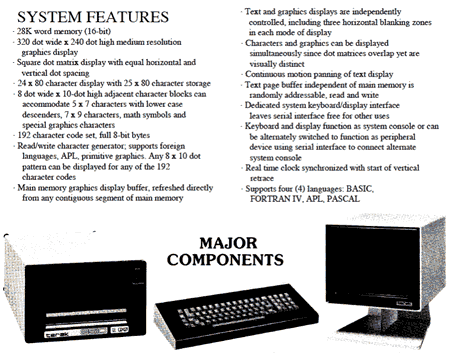
Over the past several decades of computer work, I’ve dealt with a variety of archive and backup methods. I still have a couple of 8.5″ floppy disks from the Terak system that was in the basement of Prince Lucien Campbell Hall on the University of Oregon campus when I got there in 1980.

Terak Computer System Features & Major Components

Over the years, I’ve tried to hold onto most of my personal digital output. There are still 5.25″ floppies for a TRS-80 upstairs that hold the code and most of the data for the play-by-mail gang warfare game I wrote more than twenty years before the current social network mafia games. I used to have buckets of “hard” floppies, then 44MB Syquest removable hard disks, then 250MB Syquests, but for the past sixteen or seventeen years I’ve relied on a program called Retrospect for both backup and archiving.

I came across Retrospect (originally from a company called Dantz) back in the days when I was working in the pre-press business and we were looking for a way to, duh, handle the firehose of data from four-color scans, juggle jobs on and off the limited space of the servers of the early ’90s, hold onto old scans for pickups in future jobs, and cover our butts when a machine or a server went out. With the advent of DAT tapes holding a then-inconceivable gigabyte or two of data, Retrospect — with its ability to back up multiple machines across a network, run unattended, and search for files by name or folder or date — was a literal godsend.

As the years have gone on, I’ve used it on a semi-daily basis. When I had an office outside the house and was running my own servers plus multiple workstations on both Windows and Mac, everything got backed up twice a day: mid-day and after business hours. I burned through a couple of DAT drives, then as terabyte hard drives became available I moved to those.

Archives started off on DATs as well, but I moved most everything to CD-ROM (then DVD-ROM) because of the flakiness of the tape systems. A few things got missed in the translation, but that’s my own stupid fault.

So for the past several years things have been pretty stable. My main workstation, an old dual 1GHz G4 has an external terabyte drive for incremental backups of everything it can access (the PC hasn’t been turned on for a while, but it has a Retrospect client). As jobs age out, they go onto DVD-ROM (and because I’m a little crazy about these things, I make a non-Retrospect version of the archive, as well, look for me soon on Hoarders).

The problem, of course, is that I got a new laptop to work on iPhone projects over a year ago and the version of Retrospect I’ve been using — 6.1 — won’t back up the newer OS X operating system. Since the only times I’ve broken my rules on twice-a-day backups have generally coincided with a big disk error that’s screwed me over, it’s been on my nerves. So last month I downloaded the trial version of Retrospect 8 (now from EMC) and installed it. I can back up both the desktop and the laptop now, although the engine works as a server (it runs on either a PowerPC or Intel chip) and a management tool (on the laptop, because it can’t run on a non-Intel processor). It takes a little getting used to, but the backups seem to be coming off on time. The desktop’s usually on and it runs the backup, and if the laptop’s on at the right times, it gets backed up, too.

The holidays and a cold cut into my time to play with the system for the past couple of weeks, but I spent part of this morning trying to figure out how to deal with the archives. I couldn’t seem to add them and I started to get frustrated at the lack of information in the online knowledge base. Apparently, I’d missed this important bit of info from the Read Me when I set up the trial:

Upgrading from Retrospect 6.1

Because Retrospect 8.1 does not read Backup Sets created with previous Mac versions, the installation process does not overwrite or remove existing Retrospect 6.1 (or earlier) installations. It is recommended that you continue to maintain your existing Retrospect installation to perform restores from legacy Backup Sets.

We’ve had a lot of discussion on various Director forums about whether a new, glorious version of Director would need to maintain backwards-compatibility in file format and functionality, and I tended to say “Why bother?”, but Director wasn’t a tool where one of its main purposes was to maintain archives of data.

Tomorrow

Wake up in the morning, pull myself out of bed

Think about the night before and everything I said

I made lots of promises I know that I can’t keep

So I’ll do ’em tomorrow

That seems like a pretty good idea to me

Life is moving faster, I can feel it every day

I’ve got trouble keeping up with what other people say

Big problems in the world

My life’s just a social swirl

But I’ll do it tomorrow

That seems like a pretty good idea to me

What’s wrong with tomorrow?

I’m watching him but who’s watching me?

Out my window there’s nothing where a city used to be

Phone line dead, the power gone, there’s nothing on TV

Can’t understand what happened to all the plans I made

I turn on the radio and hear the signal fade

(It’s pretty loud)

But I’ll do it tomorrow

Wall of Voodoo, “Tomorrow,” Call of the West

New Year’s Eve 1995

It was New Year’s Eve fourteen years ago when I caught a break that seemed — at least for a while — as if it would be the one that paid off. I’d quit my job to go freelance in August, doing digital prep work for a few clients I’d worked for at color shops, teaching Director — a program I’d trained myself on and with which I had a no real professional project experience — for Portland State University, doing rudimentary Web work (it was all rudimentary back then, and trying to pry some doors open in the world of multimedia by working on the newsletter for the Portland chapter of the International Interactive Communications Society.

Brad Hicks, a designer I’d worked with as a contractor at CKS Partners’ Portland office, and I were renting space from Dale Ott, a established independent designer who worked extensively with Sequent Computers, among others. Dale owned the second floor of a building at NW 14th & Marshall, across the street from Bridgeport Brewing, back before the Pearl District was the Pearl District. Bridgeport was there in 1995, but there was a dogfood factory on the block where the Safeway is now. The first floor of our building was a metal refinishing shop. A hallway on our floor had a door opening into the work area of the shop below, and the vapors could be overwhelming: I remember after working late one night that I could smell my shirt from across the room. Brad rented a room down the hallway; for $100 a month I got a 10’x9′ cubicle in the same room as Dale, his assistant, and a space very occasionally occupied by travel publisher Jim Bigoni.

The cubicle held my Mac workstation, as well as the computer I used as an internet server. I’d set up a Mac in March of ’95 on a 14.4 dialup, registered the moshplant.com domain and been running my own Web, mail, and other services using a piece of software called WebSTAR (one of the few options back in those pre-OS X days). At a time when a lot of other small developers didn’t have their own domains, I had a full access to my own server — slow as it was — and could see each transaction logged in real time.

In the fall, I’d gone to my second Macromedia User Conference. The buzz was over a new technology called Shockwave, but the seminar where they were showing it was limited in the number of attendees for some reason. I seem to recall that it wasn’t held in a regular meeting hall, and I don’t have any idea how I ended up getting in. I was a nobody. Nobody knew who I was. I didn’t know anyone at Macromedia. I don’t even remember how I found out about the seminar, but I was there.

Then I went home to wait. Shockwave for Director (one of many Shockwaves) had been shown, but I wasn’t on the beta. It wasn’t until early December that Macromedia released a public beta of Shockwave for Director. What came out then was an application called Afterburner, which took a Director 4 .dir file and compressed its data — with score and script information up front and assets following — into a .dcr file that could be viewed on in a Web browser (Netscape) with the Shockwave for Director plugin. At least, it could be viewed if you had a Windows machine, because the Mac plugin wasn’t ready for public beta. Coming as I did out of the print graphics and color retouching business, I didn’t have a Windows machine. Only one guy I knew at the time had an internet connection and a Windows machine, as a matter of fact, so in order to see my first Shockwave movie, I had to make a 50-mile round trip to Scappoose, Oregon to get Waldo (who was already working in digital video back in those days) to download the plugin so that I could see my simple animation.

They were primitive times, the mid-’90s. Everyone was scrambling to get a handle on the Web thing, and a lot of it wasn’t very pretty. Macromedia didn’t set up a listserv or a forum or anything of the sort to keep people on the public beta updated or let them pose questions. Someone just whacked together a CGI script and a form, and what we got was pretty much what you have for the comments section of a blog: a form at the bottom of a page with the comments in order of submission. Throughout the month of December, that page grew and grew in length. By the end of the month it was about 200K, which — by the standards of a day when 1K/sec. was the norm on a 14.K modem — was pretty big if you were trying to keep up on things.

Sometime in the evening, well after the hour when I should have knocked off and been thinking of an activity for midnight, I made the long reload. And there on the bottom was a lure that I couldn’t resist. It was a note from David Rogleberg, a recent emigre from a publishing company who had set up shop as Studio B, which was at that time an agency representing writers of computer books. He was looking for someone who could write a book on Shockwave and the publisher was in a hurry. I wrote an email with my name, outlining my writing credits and Director experience.

I never found out the whole story — there were rumors about a book deal that had gone south, some authors who were assigned to a more lucrative project within the company, etc. — but the hurry was a big part of it. Like I mentioned earlier, apart from my teaching gig, I’d never done any paid Director work. My only professional writing credentials were a gag piece published by the official Dungeons & Dragons magazine when I was seventeen and a short technical article written for Step-by-Step Graphics about a newspaper artist using Freehand earlier in the year, with a gap of sixteen years between the two. I’m almost certain that my undergraduate thesis is one of the shortest — if not the shortest — English theses at my alma mater. I’d never even attempted anything book-length. The audacity of thinking I could write an entire book on a barely-documented subset of a program I sort-of-knew in the wild-and-wooly field of the Web (1995 version) is only outmatched by the desperation of people who picked me to do it.

Less than three weeks later I had a contract for what became Shockwave: breathe new life into your web pages (not my choice for a title). The publisher already had a Frankenstein motif chosen for the cover (which carried through to the CD-ROM, executed by Eric Coker). I started trying to figure out what each of the limited set of Shockwave Lingo commands could be used for, what their limits were, and how those could be shown through step-by-step tutorials, something that became one of my specialties. I was able to lean on another local multimedia developer and musician, David Duddleston, for advice on the sound capabilities of that early Shockwave (as well as some sample audio). The whole thing was written and proofed in ten weeks, and it was shipping by May 1996. It looked then like it was going to be the start of a big new thing. It wasn’t, but that’s another story and since New Year’s is about new beginnings I’m going to end there.

Dumbass-ness

Since I haven’t been reading Willamette Week for a while, I only found out through my alumni magazine that Marty Smith, who I sort-of-knew long ago at Reed and for a couple years beyond, is now appearing weekly as “Dr. Know” in a Q&A column in the paper. A week ago, the question was about the costs of mountain rescue efforts, and his answer was witty and informative but it was upstaged for me by this comment’s opening line:

I don’t think you are a real doctor of anything other than dumbass-ness.

Unsubscribe

On the unsub form for the Democratic Governors Association mailing list:

Please tell us why you are unsubscribing (optional)


Bar Codes

Guess I picked the wrong decade to give up defrauding the government:

Report: Bush Admin Raised Terror Alert Based On Con Man’s Al Jazeera ‘Decoding’ Scam

Working out of a Reno, Nevada, software firm called eTreppid Technologies, Montgomery took in officials in the CIA’s Directorate of Science and Technology and convinced them that technology he invented — but could not explain — was pulling terrorist-produced “bar codes” from Al Jazeera television broadcasts. Using his proprietary technology, those bar codes could be translated into longitudes and latitudes and flight numbers. Terrorist leaders were using that data to direct their compatriots about the next target.

But Montgomery’s “technology” could not be reproduced, and the Playboy piece explains how he fell out of favor after word of what was going on spread in the CIA:

The federal government was acting on the Al Jazeera claims without even understanding how Montgomery found his coordinates. “I said, ‘Give us the algorithms that allowed you to come up with this stuff.’ They wouldn’t even do that,” says the first officer. “And I was screaming, ‘You gave these people fucking money?'” …

A branch of the French intelligence services helped convince the Americans that the bar codes were fake. The CIA and the French commissioned a technology company to locate or re-create codes in the Al Jazeera transmission. They found definitively that what Montgomery claimed was there was not.

But even after the CIA abandoned Montgomery, he appears to have convinced other agencies that his decoding technology was legit. He inked a $3 million research contract with the Air Force in January of this year. An official explained to Playboy, “We were just looking at [software] to see if there was anything there.”

The French save our asses once again.