Princess

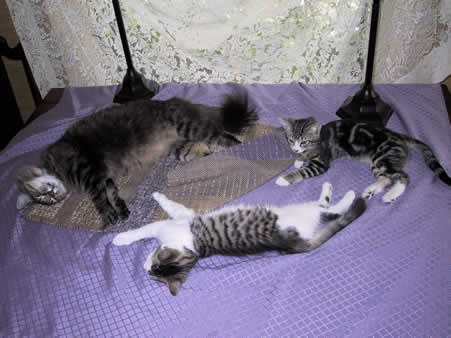
Jackie Chan, Tiger Lily, and Jasmine (front)

I wrote a long encomium to Tiger Lily on her sixth birthday last month, and I’d been meaning to do the same for her putative sister, Jasmine, when her turn came up on 26 March. But I failed.

That’s a sad thing, because despite the uninformed meanderings of some writers about how cats are “indifferent” to their owners, the reality is Jasmine is one of the most jealous animals around and would be quite unhappy if she was cognizant of the fact that I wrote about her sister and not herself.
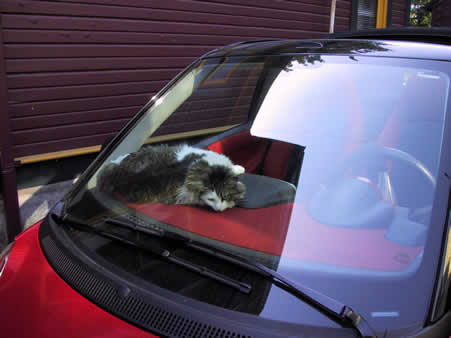
Jasmine on the smart car dash

Though she’s the younger of the two girl kitties, Jasmine is the Princess of the house. In part that’s because she’s the only one who cares about being Princess. Tiger Lily could care less, but Jasmine’s nose gets out of joint any time she perceives a slight. She is the Mistress of Sulk, and we’ve spent more time than I care to think about coaxing her out of her moods.

In this, she takes after one of her predecessors, Manderlea, who, when we lived next to a battery shop on SE 38th & Belmont, would go sit on their roof in the rain to show everyone how disgruntled she was. Jasmine has a lot of Manderlea’s mannerisms (despite the fact that the closest they ever came is the former walking over the latter’s grave in the backyard): a tendency to flounce into the room, a penchant for jumping to the highest point (refrigerator, cabinet, etc.) and perching like a vulture, and an insatiable curiosity that drives her to check out whatever Barbara’s doing. The big difference is, indeed, big: because Jasmine’s about fifteen pounds; twice Manderlea’s size and half again as big as either of the two other cats.
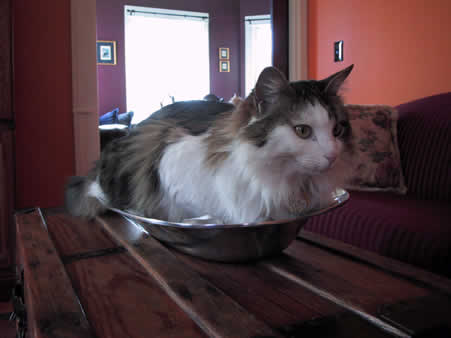
Jasmine in the platter

That makes it all the more impressive (and potentially dangerous to fragile items) when she decides to pop up on top of a cabinet from the back of a chair. Or when she decides to come down. She’s obsessed with the fishing pole toy Barbara made for Jackie Chan back in his youth (his acrobatics chasing after it was what earned him his promotion from “Boy Kitty”). She’ll pull it out of it’s hiding spot four or five times a night, but if one of the other two cats hears her chasing it and shows up to get in on the action, she’ll leave because she doesn’t like to share.

She’s the one who shows up when there’s company. She’s the one who rolls on her back on the sidewalk to get pets from passers-by. It was Jasmine squeezing her body into a tiny basket Barbara was using for tinder that’s led to us having four wicker baskets in the office and living room (for three cats!) Like she was a lobbyist or something. She’s six.
I Didn’t Get An iPad

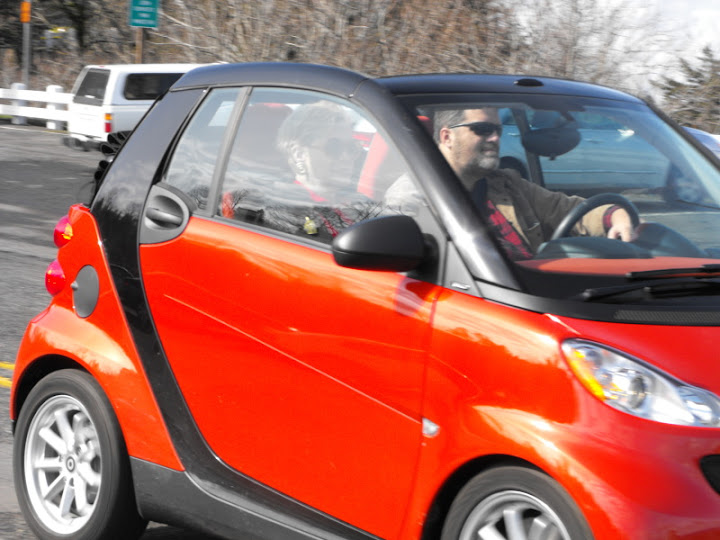
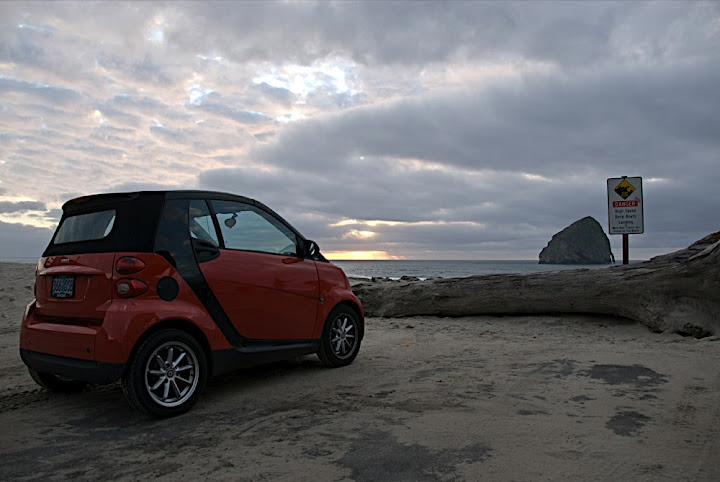
smart car at Pacific City, photo by Nathan Pryor
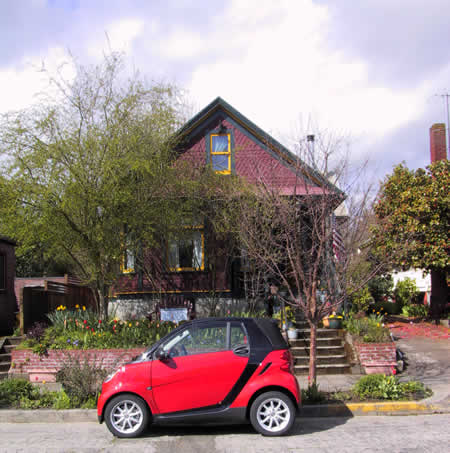
photo by Nathan Pryor

It was almost exactly eight years and eleven months ago that Barbara and I went to Amsterdam (after the wedding in Ireland of our friends Annie and Eric) and saw our first smart car.

I’ve never been much of a car guy — Barbara knows more about the workings of an engine than I do, heck, I can barely get the hood open — but I’ve always been attracted to odd cars. I don’t know why, exactly, but I suspect that it has something to do with my folks. Dad says that he taught me to recognize Karmann Ghias at an early age; he had a Chevy Corvair when my brother and I were kids; my first car was a 1975 AMC Pacer that Dad had bought for work. So I didn’t really have much of an option but to be smitten when I saw a smart parked on the street during our trip to the Netherlands in the first days of May 2001.

It was to be a thwarted obsession for several years, though. I read about the smart online. I looked at the various models and used the online configuration tools (in German). I essentially stalked smart. Then I started seeing reports about people bringing them into the US, movie stars ordering them in Europe and having to wait for months for them to arrive, and worst of all, the godawful cost of these “gray-market” cars: upward of $30K for what was supposed to be an economical city car. Way out of my league.

I persisted, however. I was even interviewed by Tom and Ray of NPR’s “Car Talk”, asking about how to get one imported (although they cut me from the show; they didn’t really have any advice to offer). So it just remained an unscratched itch for years. (Meanwhile, on a trip to Germany, Dad had acquired his own hankering for a smart roadster).

According to the Department of Energy, on 2 April 2001, a gallon of regular gasoline on the West Coast was selling for an average of $1.54, which was half again what it had cost two years before. So to my mind, even back then, it seemed like a move to smaller vehicles might not be such a bad idea. Five years later, it cost a dollar more. In the summer of 2008, the price of a gallon of regular on the West Coast spent six weeks above the $4.20 mark, a 175% increase over what it had cost the month before we went to Amsterdam.

smart car's first day at home

But in early 2007, a notice went out to interested parties that there was finally going to be an official importation of smart fortwo models (the roadster had been discontinued) into the US. For a $99 refundable deposit, you could reserve a car. Later in the year, people who’d plopped down their hundred bucks got a chance to choose their options and order up their car. Of course, between the time I put down my deposit and the time I got to configure my smart, I’d been laid off from my job, but I didn’t let that deter me: obsession knows no recession. Red, with red interior and a cabrio top to make the most of the sunny days.

A smart dealership opened up in Portland in January 2008 and they started getting in about 30 or so cars a month. I got the call April, and I picked up the smart car two years ago today.

Barbara and Darrel on the road,

Underwater

I’ve been reading Michael Lewis’s book The Big Short: Inside the Doomsday Machine, about the people who found a way to make a load of money betting on the collapse of the subprime mortgage market. Over the past decade, I’ve often wished I’d had money to invest in a way to express my feeling that the residential real estate market in the past decade was a house of cards, but as the book points out, it wasn’t enough to merely have the money. The people Lewis profiles also had to figure out how to bet against the conventional wisdom; one of the guys he writes about actually invented the type of trade that the others used to make their billions. Either way, no millions for Darrel.

I can’t help but feeling that we’re going to see some similar stories coming out of the commercial real estate market. A report that came out last month from TARP Congressional Oversight Panel Chairwoman Elizabeth Warren predicting that half of all commercial mortgages would be be “underwater” by the end of this year has been getting some play this week.

From the report’s Executive Summary:

Between 2010 and 2014, about $1.4 trillion in commercial real estate loans will reach the end of their terms. Nearly half are at present ― underwater – that is, the borrower owes more than the underlying property is currently worth. Commercial property values have fallen more than 40 percent since the beginning of 2007. Increased vacancy rates, which now range from eight percent for multifamily housing to 18 percent for office buildings, and falling rents, which have declined 40 percent for office space and 33 percent for retail space, have exerted a powerful downward pressure on the value of commercial properties.

The largest commercial real estate loan losses are projected for 2011 and beyond; losses at banks alone could range as high as $200-$300 billion. The stress tests conducted last year for 19 major financial institutions examined their capital reserves only through the end of 2010. Even more significantly, small and mid-sized banks were never subjected to any exercise comparable to the stress tests, despite the fact that small and mid-sized banks are proportionately even more exposed than their larger counterparts to commercial real estate loan losses.

Presumably, the larger size and smaller quantity of commercial loans (as compared to residential loans) precluded the dive in lending standards that led to stories like the one Lewis recounts where a California crop picker making $14,000 a year got a loan for a $750,000 home, or the baby nurse of one of his profile subjects whose mortgage lenders convinced her to leverage a single townhouse purchase in Queens into five townhouses, but it would be a mistake to think that bankers, developers, and businesspeople are somehow smarter about money just because they have more of it. Someone, after all, lent the money to the crop picker and the baby nurse to buy the house, someone built the houses thinking they could sell them, and someone lent the builder money to build the houses they thought they could sell.

As Lewis elaborates, the initial act of lending the money to the home buyers isn’t where the real money was. It was the bond market — where mortgages were bundled into packages of several thousands and traded between investors and second and third-generation trade instruments were created that simultaneously magnified the volume and obscured the risk of the original mortgages — that was the scene of the real crime. And after reading Lewis’s book, I can’t help but suspect that, while I still don’t have the money to do any investing, that there are probably collateralized debt obligations and credit default swaps aplenty to be heard of coming from commercial mortgages.

Rand Takes the Train to Portland

Kohler Fountainhead ad

Barbara saw this Kohler ad by San Francisco photographer Mark Holthusen and was struck by the odd juxtaposition of elegant woman and toilet. My immediate reaction was: Isn’t that Portland’s Union Station tower Photoshopped into the background? And isn’t a $4,400 toilet with “integrated bowl lighting” an appropriate item to be named the Fountainhead and sold by an idealized version of Ayn Rand?

HISTORICAL NOTE: Almost exactly 20 years ago, Barbara was the one who unmasked the use of Barbur Boulevard’s Capitol Hill Motel in a photo illustration accompanying a SPY Magazine article about philandering congressmen.

Smiling Faces

Today is the 15th anniversary of the day I registered my first domain: moshplant.com, which was the kickoff to my career (such as it was or is) as a freelance Director and Flash programmer. I don’t remember picking St. Patrick’s Day for any reason, in fact it wasn’t until I started marking the date on my site after about ten years that I even noticed that it was March 17.

The original moshplant.com ran on a Mac Quadra 630 with an external 200MB hard drive, using StarNine’s WebSTAR suite of server tools, which included a web and mail server. One of the truly cool things about WebSTAR’s web server was the ability to watch the access logs in real time; I felt it gave me a very ground-level view of how things worked.

The whole thing was connected to the Internet via a dedicated phone line with a 14.4 modem connection. I had faster modems, of course, but for those of you made fat and lazy by the inexpensive high-speed access we’ve come to know and love, getting a static IP address even with a slow data rate wasn’t cheap in those early days.

Fifteen years is a long time. Some days it seems even longer. Apropos of nothing, one of my favorite songs:


The few surviving samurai
Survey the battlefield.
Count the arms,
The legs and heads,
And then divide by five.

Drenched in blood,
They move across the screen.
Do I need
To point
Or do you
See the one I mean?

The one in back,
The way he acts,
Is he reminding you of anyone we know?
Isn’t he so
Like certain people I could name?

Halfway through the 30 minutes
Halfway ’round the world.
Here’s the story of
The genocidal overlord.

In her palace
With her epaulettes
Watch her little gestures
As she lights her cigarette.

Look at her you
Must see it too
Is she reminding you of anyone we know?
Isn’t she so
Like certain people I could name?

Disembodied and detached
A voice describes the scene
As a lizard
Stalks a helpless
Creature on TV.

Music underscores
The tragedy.
Eyes with no expression
Watch the unsuspecting prey.

Who is it like?
Doesn’t it strike
You as the very image of someone we know?
Isn’t it so
Like certain people,
How could anybody
Miss the obvious
And the uncanny
And the clear resemblance?
Isn’t it just
Like certain people I could name?

They Might Be Giants, “Certain People I Could Name”, They Got Lost

Libcooties

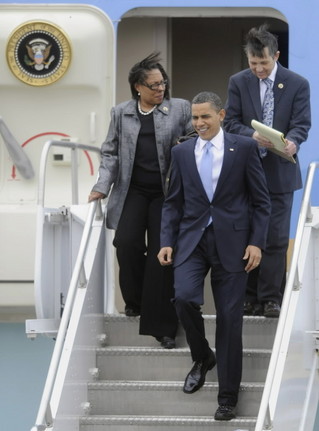
Marcia Fudge, Dennis Kucinich, and Barack Obama leaving Air Force One

It must just kill some people to have seen the picture of Dennis Kucinich getting off of Air Force One yesterday. He’s theDFH the people who claim they’re DFHs can’t stand. A post-1972 McGovern of his era, in neat, pocket size. If you’re the slightest bit insecure about your own liberalism, there’s no way you can have Dennis Kucinich around, because he just reeks of libcooties.

LOOKSTRONG!

Miss Director

The last copy of Director I upgraded to was MX 2004 (aka “Director 10”). I haven’t had any Director projects since I was laid off from Reality Engineering nearly three years ago, and the only Director-related project I’ve had was a prototype for an online (Flash) update of a 1994 Director product. MX 2004 wasn’t much use there; I had to switch into Classic OS 9 mode and run Director 6 just to open the DIR files. My role in that project came to an end in February 2008. Upgrading hasn’t exactly been a priority.

I’ve always loved using Director for utilities, though. I’ve built any number of quick-and-dirty text processing tools for myself over the years, including a web log processor for my first server back fifteen years ago. I’ve used it to batch process images from time to time since Director 8. I’ve even just used the JavaScript engine to test functions and processes I put into web pages.

Most recently, as I’ve been working on a poker-related iPhone app, I wrote a poker hand evaluator in Lingo that I used to generate statistics on 500,000 hands for 2-12 players and output the results out as an XML file. Even my old dual 1GHz G4 desktop computer can evaluate 1,000 12-handed hands of poker in less than 4 seconds. You’d think that a faster processor, say one of them Intel thingies, really push through the numbers. My 2GHz Intel Core 2 Duo laptop runs Apple’s Snow Leopard OS 10.6, however, and Director MX 2004 won’t run on it. I still do a lot of my work on my desktop (what with the never having to leave the house for work) but it’s irritating not to be able to whip up something in Director when I want to.

I’m trying Parallels out to run Windows on the laptop, maybe I’ll see about setting up my Windows copy of Director there.