Digitized Decade: Wry

It’s hard to remember—in this world where every cell phone has a camera, you can have a face-to-face video conversation from a smart phone, and even Barbie is enhanced with more than just plastic breasts—that the whole digital photo thing didn’t hit the consumer world more than about ten years ago.

Digital cameras weren’t exactly new. Working in the printing business in the early 1990s I’d been around as the early professional models were having the kinks worked out of them. Those cost tens of thousands of dollars and most were tethered to a computer for storage. But it wasn’t until 1999-2000 that the first models broke the $1,000 price barrier. Being the good little digital consumer that I was I went out to buy one.

Barbara and I were heading to Hawaii just after Christmas, along with my parents and brother and neither of us had a camera that was in working order. I bought what was then a relatively low-end but decent-quality model: the Canon PowerShot S20.

The S20 had 3.3 megapixels of resolution, which was somewhat offset by the fact that the memory card that shipped with the camera held only 8MB. It being the beginnning of the digitized decade, extra memory chips weren’t in every Walgreen’s or corner grocery; you had to order them online or go to a photo shop and pay an outrageous price to expand to 16MB or—if you were packing a wad of cash—32MB. Or take a few shots and download them to your computer ASAP. I deleted a lot more shots directly from the camera back in those early days than I do now when I have the luxury of a memory chip with literally orders of magnitude more capacity.

The S20 got a lot of work in its first months. A slip on a path in Hawaii dropped it on lava rock, leaving a dent on the corner next to the flash. A couple of weeks later I was in San Francisco for a meeting at Macromedia of the “Director Advisory Council.” Back to San Francisco in February for one of a FlashForward conference (oddly, I don’t appear to have taken any photos of the last trip I made to NYC, in April for the Macromedia UCON). Then it was off across the country and the Atlantic for the wedding of my friends Eric Rewitzer and Annie Galvin in Ireland, followed by a stay with Director developer James Newton, and a week in Amsterdam where we met up with even more Director folks.

Eric, who was working in the middle of the digital media world at Apple at the time, told me in later years that I was one of the first people he knew with a digital camera and that the pictures I sent them of the wedding and surrounding events were the main digital record they had. That wouldn’t happen now.

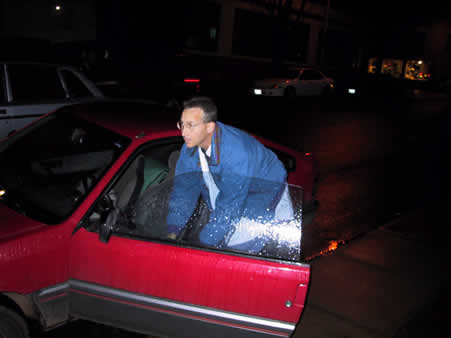
The Canon’s sort of a brick compared to my iPhone or the svelte, higher-resolution cameras you can pick up for an eighth the price I paid a decade ago, but it still takes good photos and it’s been stolidly reliable. Below is a picture of an old friend of mine after work as we were getting ready to grab a beer. It’s the fourth picture I took with the S20. The first three photos were deleted long ago.

Brian Wry, 21 December 2000

The Digitized Decade is a look back at the first year of our entry into consumer digital photography.

Unequal Pairing

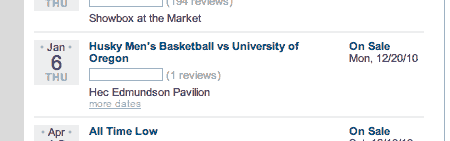
From the list of offerings at TicketMaster this month:

Husky Men's Basketball

As a man of larger size myself, it doesn’t really seem like a fair match.

Shining Critical Path

Kudos to Critical Path Software for getting gobbled up by eBay.

A dozen years ago, back when I had an office across from the then-under-construction Westin Hotel, Critical Path was in an adjacent building on the northwest corner of SW Broadway & Alder. My office partners, graphic designer Brad Hicks and Flash developer/animator Peter Sylwester collaborated on a web site for the Critical Path, with Brad designing the fish skeleton logo that they’ve used ever since and Peter helping to get the whole thing into shape.

A couple of times, Critical Path asked me to collaborate on bids when the projects they’d been asked to take on included Director content—most of their work at the time was Mac ports of software, from hardware drivers to CD-ROMs—but it wasn’t until they brought me the first of the UbiSoft CSI games (which included some Shockwave 3D content) to port to the mac that I actually was able to do anything for them. I managed to help out on a couple of other projects in the years since.

A number of the folks I play poker with have worked for (or are working once again for) Critical Path, and every time I’ve talked to CEO Steve Romero I’ve told him I need to invite him out to pay him back for having us over a party. That’s probably going to be a harder date to make now that he’s a vice president at eBay!

Why We Raise

Bonehead play of the night. We were more than two hours into a tournament limited to eight players per table and full up at 1,000 players. I’ve been playing a fairly tight, aggressive style that’s got me in around 50th place among the 240 remaining players. 104 places get paid, $750 goes to the top spot, but you need to make at least sixth to break triple digits from your $4 buy-in.

I’m on the button with QcKc. We’re in Level XII, blinds are 150/300 with 40 ante. UTG+2 (with about 17K in his stack) raises to 600 and the cutoff position (the table leader with 27K) calls. I call when I should have re-raised. The big blind (with 22K) calls.

The flop drops a Tc8d8c on the table. The big blind checks to UTG+2 who bets 600. The cutoff calls and this time I re-raise to 1,200. The big blind makes a pot-sized raise to 5,100, which is called by UTG+2 but drives out the big stack. I call, leaving me with over 12K behind. There’s almost 19K in the pot.

After a 6d shows on the turn, the big blind tries to take the pot down with an all-in of almost 17K. That drives out UTG+2, leaving me heads-up wondering if I can snag a club on the river. I’m reasonably certain the big blind has a set of 8s which I can only beat If I call, I’m out if I don’t. I shove my last 12.3K in.

As it happens, the river gives me my club but it’s another 6, making a full house for the guy who was holding 8s9h which I doubt he’d have kept if a substantial re-raise had been made by me in the pre-flop betting.

Ho-Ho-Hum

I thought that Harold White—the mayor of Aumsville, Oregon where a tornado hit yesterday—was remarkably collected during his press conference just a few hours after it ripped through the town of 3,500. For someone faced with something as rare as a tornado in Oregon, who presumably doesn’t have to run a lot of press conferences, he managed to get the right questions to the right agency chiefs with aplomb.

One of the KGW reporters on the scene? Their take was that White seemed “ho-hum” about the whole thing. Seriously, I know there are endless hours of newshole to fill with blather, but “ho-hum?”

Priorities

I’m glad the FBI has developed the capabilities to ferret out young men with murder on their minds in places like Portland and Maryland, but it does make me wonder if some of the energy needed for supporting an operation that builds fake bombs and people to track these targets for months on end could possibly have been spent looking for people like Byron Williams who was actually on his way to kill people with real bullets when the California Highway Patrol tried to stop him for reckless driving.

Lucky

I may have jinxed myself writing about the PokerStars Mega-Path tournament yesterday so cavalierly. Really, when I told people I might have to hire a private plane to make it back for the local quarterly tournament I meant it as a joke!

I lasted all of 18 hands, losing nearly a quarter of my chips early with QhTh and a flop that that paired the ten but drew out to an ace-high straight on the river. The starting stack of 1,000 and the turbo structure with blinds coming in on Level III are unforgiving of mistakes, bad luck, and weak hands. While I got a few face cards and a couple aces in my final hands they weren’t matched with anyything above a six.

Still, I’m lucky to be playing poker at all. It was eight years ago today—just an hour or so after I’m writing this—when I collapsed on the stairs of my office with a pulmonary embolism after having broken my leg two months (to the day) earlier. The doctors said that with the number of clots I had in my lungs I’d had about a 60% chance of dying before I got to treatment. But here I am. That’s in the general ballpark of the chances of getting knocked out of the Mega-Path. I’ll take the trade-off.

Tomer Berda’s in the Czech Republic for the latest European Poker Tour event starting tomorrow. He’s currently #7 on the EPT Player of the Year leaderboard. We’ll be watching his Prague-ress.

Glide Path to Nassau

Today was Round 3 of the PokerStars Caribbean Adventure (PCA)Mega-Path tournament and I made it through without much of a problem. The prize at the end of the Mega-Path is a package that includes the $10,000 entry fee for the PCA Main Event, hotel accomodations at the Atlantis Resort & Casino in The Bahamas, and cash for travel expenses. Personally, I’d rather have made it to the European Poker Tour events I tried for this fall in Vienna, London, or Prague—mine is not a hot-weather body—but I’m making a stab at PCA nonetheless.

You can jump into the Mega-Path for ever-larger amounts of Frequent Player Points (FPP). Round 3’s entry cost was 500 FPP but I entered through a 5 FPP Round 1 tournament that allowed for 60 minutes of unlimited re-buys without rebuying myself (later rounds don’t allow re-buys). The interesting thing about the Mega-Path is that between 1/3 and 2/5 of the players in each round get through to the next round. The hard thing is that there are nine rounds.

There’s a mixture of regular-speed games with 10-minute blind levels and turbo games with 5-minute blind levels. Depending on which games you sign up for, even the structure of a specific round can be different. This is my own Mega-Path:

Round (FPP buyin) completed 1 (5+R)
2 (200)
3 (500) 4 (1,500)
5 (4,000)
6 (12,000)
7 (36,000)
8 (107,000)
Final (321,000)
Starting Chips 1,000 2,500 1,000 3,000
Minutes per Level 5 10 5 12
Small Blind/Big Blind[/Ante]

10/20
15/30
25/50
50/100
75/150
100/200
150/300/25
200/400/50
300/600/50
400/800/75
600/1,200/100
800/1,600/150

10/20
15/30
20/40
25/50
30/60
40/80
50/100/10
60/120/15
75/150/20
100/200/25
125/250/30
150/300/40

10/20
15/30
25/50/5
50/100/10
75/150/15
100/200/20
150/300/30
200/400/40
300/600/60
400/800/80
600/1,200/120
800/1,600/160
10/20
15/30
20/40
25/50
30/60
40/80
50/100/10
60/120/15
75/150/20
100/200/25
125/250/30
150/300/40

At least in the early stages it’s an exercise in math and patience. Unlike most tournaments where only a small percentage of the field gets any reward and even then only the top position receive a significant multiple of their buy-in, the Mega-Path gives exactly the same reward to someone who has the most chips as it does to someone who has 10 chips when enough players have been eliminated. Presumably, the competition gets a bit more challenging as the field concentrates—something this player seems to have observed as he got knocked out after surviving eight rounds last year—but there’s no need to be a hero to reach the goal. If you can get some traction in the early stages and build your stack you can afford to blind off and glide to a ticket for the next round.

I’m sure someone’s done the real math on this, but in a tournament a third of the field making it to the money, obviously two-thirds of them need to be eliminated. Because the number of chips is constant, at the end of the tournament the chip average will be three times the starting chip value. For example, if a tournament has 900 players with 1,000 chips each, there are 900,000 chips in play and when only a third (300) of the field remains, the chip average will be 3,000. Obviously, not everyone will actually have that many chips at the end and in many cases the chip average is higher than the chip median; a few hogs will have amassed a huge number of chips, offsetting the fact that many players will have less than the average. That doesn’t matter for the Mega-path, though. Everyone’s equal in the eyes of the Mega-Path (except for the folks who don’t make the money at all).

What I did for level 3 is to put together a calculator, into which I enter the number of players at the table, the number of rounds per level, the blind structure, and the expected final level of the tournament. Needless to say, none of this is exact and I made sure I had some leeway in my calculations. A table isn’t always full, meaning blinds come around more often and you burn through chips faster. Hands take a wide variety of time to play out; I analyzed one tournament with hands that ranged anywhere from 14 seconds to almost a minute-and-a-half, with a median of 40 seconds. The length of a tournament is particularly troublesome to predict, as the Mega-Path tournaments are someone unique and are difficult to compare to the lengths of recorded tournaments. Just for a rule-of-thumb I figure for a tournament with a third of the field reaching the money that the last level will be played by the time cumulative blinds and antes have reached a level where the would eliminate a stack about one-and-a-half times the size of the starting chips.

This yields a series of target values for each level that starts off high in Level I and decreases increasingly quickly to the final expected level of the tournament. If I can get to the target value by the end of a level, my calculations show that all I need to do is wait for the blinds (or other players) to take care smaller stacks. The trick is to make the right calculations. And to get to the target.

I put it to the test today in Round 3. I started off OK but got into a bit of a hole on my second big blind, dropping 300 below the 2,500 starting level. With blind just at 20/40 I wasn’t particularly worried. Triple sevens on the next big blind and an AJo on the hand after that put me back up over the chip average before the end of the level. Pocket 7s that tripled up on the flop put me over 1.5 times the starting stack in Level IV. A pair of uncalled jacks pushed me over 4,000 a few hands later. QcTc that I played out from a four-flush on the flop to a flush on the river beat a pair of kings and earned me over 1,000 chips that topped me over 5K. I reached 6,000 chips about 140 hands in during Level VII, but I thought that might be a bit short still.

ThQc
paired another queen on the flop and beat out a smaller pair (with flush draw), an AKo that missed everything, and another queen with a smaller kicker for a pot of almost 3K that put me up to 7K shortly after the start of Level VIII, well over my estimate of what I needed by that point. From there I folded everything for all but one hand where I accidentally hit the bet button on the turn and drew into a king-high flush with Jd6h, winning 900 chips. Didn’t even play the QdQc I was dealt on my last hand, even with 4,535 chips. According to PokerTracker’s chart of all-in expected value I played the hands perfectly, with no craziness on my part. I won when I was supposed to win and lost when I was supposed to lose.

Round 4 is tomorrow morning. If I make it through that, the next five rounds are stacked up in a row on Boxing Day. The PCA Main Event itself (as opposed to the numerous other PCA tournaments) begins January 8 and runs through January 15. That may conflict with the second quarterly event for our poker league.
Birthday Poker

Apparently I was at the wrong poker tournament on my birthday Monday when the guys I’ve been playing with beat the snot out of me. Oh, sure, my cousin sent a nice cake and a card as well as $5 for the add-on which mitigated my loss slightly, but apparently at one tournament they know how to treat players turning over another year.

Antonio Esfandiari Makes Birthday Magic at Bellagio

At Bellagio in Las Vegas, Antonio Esfandiari outlasted one of the toughest final table lineups in recent World Poker Tour history to grab his second WPT title at the Five Diamond World Poker Classic – and he did it on his birthday, no less.

Then again, I don’t think I could get my cousin to even slightly mitigate a $10,000 buy-in.

Nit-in-Chief

My poker and politics obsessions come together in a post at the Cake Poker blog that refers to a story by Randall Lane about Barack Obama’s poker-playing days in Illinois in The Daily Beast:

Lane puts all this information together and says that Obama’s concessions to the Republicans on the tax bill, the federal wage freeze and “unreciprocated health-care and fiscal concessions” that they’re confident in their ability to bluff the president. That’s bad news for him since the Republicans will be in control of Congress for at least the next two years, where they’ll have plenty of time to make him fold his medium-strength hands to their unsuited garbage. If the president is as big a nit as The Daily Beast suggests, he’d better hope his stack doesn’t dwindle to where he has no fold equity before the next election.

You can probably make out the sense of that without knowing the specific terminology, but a “nit” is someone who us si risk-averse that they can often be forced out of a hand they’re not absolutely sure of. “Fold equity” is the amount of money you can bet to force other players to back down; if you don’t have many chips it’s difficult to protect weak hands or to bluff because it costs little for others to match your bet.

As I wrote back in July, poker is a game of imperfect knowledge, unlike tic-tac-toe or chess. You can sometimes be sure you have the absolute best combination of cards but that’s not the usual situation, particularly in the early stages of betting in a hand when you only know about a portion of the cards that will be dealt. This is from Lane’s article:

“He wasn’t a bluffer,” says [Will County executive Larry] Walsh. “When Barack was betting, you could pretty much know that he had a hand.”

[State Senator Terry] Link remembers more bluffing, to a point: “He bluffed, with the cards. He wasn’t going to bluff with a total longshot.” In poker parlance, this is known as a semi-bluff: even if you’re called, you still have a so-so hand as insurance.

And if his opponents bluffed? Both Link and Walsh remember Obama as disinclined to engage unless he already held an overwhelming advantage. “If he was chasing [another card to complete a straight or flush], he’d give her about two shots and then fold,” says Walsh.

If nothing else, John Boehner, Mitch McConnell and the GOP Republicans have demonstrated their bluffing proficiency. Obama confirmed as much at yesterday’s press conference: “I have not been able to budge them. And I don’t think there’s any suggestion anybody in this room thinks realistically that we can budge them right now.” There’s only one way to find out, but Obama, lacking an overwhelming hand, has been unwilling to do so over the first two years of his presidency.

Then again, the other possibility is he’s getting exactly what he wanted.