Digitized Decade 2: I See Stephane Comeau!

[click to enlarge]
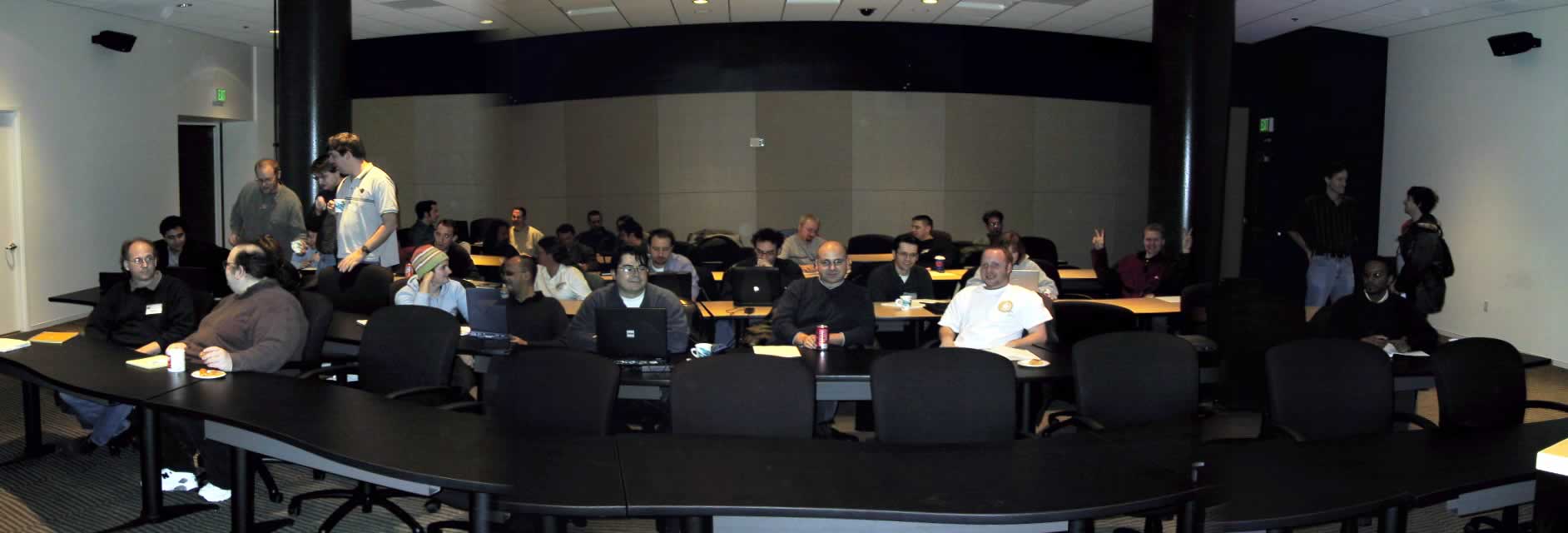
Director Advisory Council 2001

It’s the latest game sweeping the nation! This three-photo panorama was taken at the first event I attended with my then-new digital camera, ten years ago today. It’s a meeting room in Macromedia HQ where a number of Director developers were given a close-up look at Shockwave 3D (then nicknamed “Tron”) which would be released at the Macromedia User Conference the following spring. Name as many developers as you can!

Here’s a preliminary agenda for the upcoming Tron Beta Seminar here at Macromedia January 18th and 19th (1 week away!). So far we’ve got 46 attendees, with room for 53. Submit requests for attendance directly to me. Hope to see you here. (Note the special opportunity for showing your own stuff to the group Thursday evening)

Thursday January 18th

Time Session / Speaker

9:30am Hello and Introductions / James Khazar
Coffee & doughnuts

10:00 Tron Basics Seminar
Terry Schussler
Terry’s a great teacher and he’ll
be giving us a good part of a day
with a high-level overview of what
it takes to get cool stuff built
with Tron. Lunch in there somewhere.

5:30 Q&A / Terry & Engineering
Your chance to ask the experts
about Tron

6:00 Snacks and Show&Tell
to Several of our partners and your
when- fellow developers have a chance
ever to show off some cool stuff.
>>> If you’d like to participate,
>>> let me know directly.

Friday January 19th

Time Session / Speaker

9:30am Good Morning Mixer
Bagels

10:00 3D Max Optimizations and Workflow
Jeff Abouaf, our resident 3D Max
expert will show you the tricks
and gotchas of bringing your
3D Max models into Tron.

11:00 3D Behaviors
Kraig Mentor, Director Engineer
and author of the new 3D behavior
set talks about their use and
other lingo goodies.

12:00 Tron Tips
Tom Higgins, QA staffer and
3D aficionado demonstrates his
vast knowledge of Tron.

12:30 Lunch & Demos
How’s Pizza sound?
See some cool short demos.

2:00 Multiuser Server
David Simmons, the Godfather of
MUS, shows off the new features.

2:30 QA Scenario Test
Christophe Leske and Buzz Kettles
walk you through our Zoombot
case study.

3:00 Sapient’s Real World Experience
aka Human Code, they’ve developed
some complete projects for us with
and will take you through their
experiences with Tron.

3:30 Engineering Team Managers Tell All
Meet the Director Team managers

4:00 Marketing and Promotional News
Find out how we plan to make Tron
the biggest thing to hit the web
since browsers and how we can help
promote your Tron infused site.

4:30 Q&A part duex
Last chance to put your questions
directly to the team

5:30 End of Day

The Digitized Decade is a look back at the first year of our entry into consumer digital photography.

Bringing a Microphone to a Gun Fight

Personally, I think the people who have been blaming hate talk radio, Tea Party shouters, and politicians het up about Kenyan birth certificates and socialism for the string of violence and near-violence of which the Tucson shooting last weekend is just the most recent have it all backward. Those people didn’t make Jared Lee Loughner kill three senior citizens, a federal judge a young man, and a little girl. They didn’t pull the trigger on the Glock that sent bullets through the brain of Representative Gabrielle Giffords and into a dozen others. They’re just not as limited in their opportunities, patience, or skills as Loughner was.

A report by Alix Spiegel on NPR’s Morning Edition today delves into a 1999 study of assassins and would-be assassins conducted for the Secret Service by an agent and a psychologist. They studied people both well-known and obscure and came to the conclusion that:

…rather than being politically motivated, many of the assassins and would-be assassins simply felt invisible. In the year before their attacks, most struggled with acute reversals and disappointment in their lives, which, the paper argues, was the true motive. They didn’t want to see themselves as nonentities.

And one thing [professor Randy] Borum and [psychologist Robert] Fein say about choosing a political figure — as opposed to choosing a show-business celebrity — is that the would-be assassins are able to associate themselves with a broader political movement or goal. That allows them to see themselves as not such a bad person. In this way, Borum says, assassins are basically murderers in search of a cause.

“There’s nothing crazy about thinking that if I attacked the president or a major public official, I would get a lot of attention. I would get a lot of attention. My goal was notoriety,” Fein says. “That’s why I bought the weapon.”

In the case of politicians, talk radio hosts, and Fox News pundits, they have a weapon that’s not going to get them put in jail. The payoff for what they do—in notoriety, money, and freedom—is far greater than any mere physical assassin. Police aren’t likely to shoot them. They aren’t going to go to jail. If their particular brand of vitriol catches on they get invited on TV and radio, they get book deals, and they might even get their own show or elected to office.

Of course, it didn’t really take a study for someone to figure out that assassins just want to have fun. The Secret Service could just have hired Stephen Sondheim and John Weidman, who’d figured it out while writing the musical Assassins a decade earlier and expressed it in the song “Another National Anthem”:


[SAM BYCK (attempted to hijack a plane to crash into the White House and kill Richard Nixon)]
I deserve a fucking prize!…

[LYNETTE “SQUEAKY” FROMME (attempted to shoot Gerald Ford)]
I did it so there’d be a trial, and Charlie [Manson] would get to be a witness, and he’d be on TV, and he’d save the world!…

[CHARLES GUITEAU (shot and killed James Garfield)]
Where’s my prize?

[BYCK]
I did it to make people listen.

[LEON CZOLGOSZ (shot and killed William McKinley), FROMME]
They promised me a prize…

[JOHN HINCKLEY (shot Ronald Reagan)]
Because she [Jodie Foster] wouldn’t take my phone calls-

[ALL (Except Zangara)]
What about my prize?

[GIUSEPPE ZANGARA (attempted to shoot Franklin Roosevelt, killing Chicago Mayor Anton Cermak)]
Because nothing stopped the fire-!

[ALL (Except Byck)]
I want my prize!…

[BYCK]
Nobody would listen!

It’s a pretty easy path for the right-wing pundit. The money flows like the hate. But there can only be so many of them on the air at once and not everyone has the gift of the golden tongue. Not everyone who wants the attention can manage to keep it together long enough to make it through their crisis point.

“They experienced failure after failure after failure, and decided that rather than being a ‘nobody,’ they wanted to be a ‘somebody,’ ” Fein says.

They chose political targets, then, because political targets were a sure way to transform this situation: They would be known.

Married, with two kids, Beck barely held things together; ratings at New Haven’s KC101 were sinking, and his salary and responsibilities were being slashed. “Every single minute of every single day was a struggle for me,” he says. His worst moment: blacking out at night, then breakfasting the next morning with his kids when “they said, ‘Dad, Dad, that was the best one ever, tell us that [nighttime] story again.’ I realized that not only could I not remember the story, I didn’t even remember tucking them in.” Beck took himself to Alcoholics Anonymous. But he credits Tania, his second wife, whom he met three or four years later, for pulling him out of the deep ditch. At her insistence they shopped around for a church and became Mormons.

In the late 1990s (Beck is fuzzy on dates), while filling in as a talk radio host at WABC in New York City, Beck got a lucky call from media agent George Hiltzik, who had been tipped off by the program director. Beck told him he had an offer to do talk radio in Tampa. Hiltzik was impressed with Beck’s passion–and his urge to make a lot of money.

—Lacey Rose, “Glenn Beck Inc”, Forbes (04.08.10)

Loughner got his prize. It just comes with a bit harsher center than the prizes Rush Limbaugh and Beck take home.
Make Or Break Time


I’ve told myself
So many times
Not to turn into the type
But I’ve found
Is it too late?
Has my time come?
Sometimes I think I’m losin’ it
Am I the only one?

Understanding, more like demanding
Where do the grey skies end?

So should I stay
Or fly away
The wings that I begin to grow
Will surely let me know
How far I have to go
And I’ll be there

Oh yet again
Thought I was right
But as usual
I end up
On the wrong side of the fence
Is it too late?
Has my time come?
Sometimes I think I’m losin’ it
Am I the only one?

Understanding, more like demanding
Where do the grey skies end?

So should I stay
Or fly away
The wings that I begin to grow
Will surely let me know
How far I have to go
And I’ll be there

—”Fly Away”, The Living End, The Living End

The Play’s the Thing

Barbara and I were talking about Reed playwrights after watching the rebroadcast of the second episode of Treme the other night. Eric Overmyer (’73) is executive producer and writer on the series—set in the months after the flooding of New Orleans—and he’s also worked on a couple of other critically-acclaimed shows: Homicide: Life on the Streets and The Wire among them.

Today’s mail brings a flyer from the Reed Alumni association about Lee Blessing who graduated a couple of years before Overmyer. Profile Theater, in the Theater! Theatre space in my neighborhood is doing a staged reading of Blessing’s new work, When We Go Upon the Sea, in a couple of weeks (in addition to producing several other Blessing works this year). I cannot recommend Fortinbras enough for serious but humorful Shakespeare aficianodos.

When We Go Upon the Sea is described in the flyer as exploring “a future, in which President George W. Bush is put on trial for international war crimes.” I have to say that I find this sort of amusing because the one act play I wrote for my playwriting class twenty years ago at Reed was “Ollie North, 2000 A.D.,” with a sort of similar premise. It starred my classmate (not from playwriting) Scott Quinn as Ollie North, local cinephile D.K. Holm as The People, and Barbara as Fawn Hall. I lost my digital copy years ago but D.K. gave me a copy of the script a few years ago. I may have to dig it up and wander over to the show.

Uncivil Defense

Just watched the end of the 2010 version of “The Crazies”—one of the latest entries in the “fast zombie”-style movies of recent years—and aside from the typical huge number of plot holes in any zombie movie it ends as many zombie movies do with a nuclear explosion to wipe out the infection. The two main characters are speeding away from the afflicted area in a big rig, listening to the last thirty seconds of a countdown (presumably they’ve seen zombie movies), asking each other repeatedly “Do you see anything?”

Now, apart from the fact that a truck speeding away from—well, anything—isn’t going to cover even a mile unless they’re going 120 miles an hour, so perhaps it might be a good idea to get the rig pulled over and hunker down rather than be hit by the shockwave while you’re moving at full speed, anyone should know that you don’t look at the nuclear explosion.

A couple of generations of children had that drummed into them. I took an afterschool class taught by the former head of local Civil Defense when I was in third grade. “Duck and cover” may be a joke but you don’t look at the sun unprotected and you don’t look at the nuclear explosion.

Inconvenient Truths Are … Inconvenient

As I mentioned back at the beginning of November, Portland blogger Jack Bogdanski banned me from commenting at his site (again) for a throwaway comment about how I didn’t think a City of Portland web page on living car-less amounted to “hectoring.”

I’ve tended to check his site less and less—not being a believer in one-way communication—but what the heck, it was Christmas Eve and I was looking for distraction from my work. I ran across a one-line comment link he made about why Oregon’s population didn’t grow as fast as Washington’s over the past decade, which linked to a Washington Examiner opinion piece by right-wing economist Michael Barone. Could it be “lack of a personal income tax?”

Barone’s article doesn’t mention Washington or Oregon although he rhapsodizes at length about “diversified,” “business-friendly,” “low-tax” Texas. Bogdanski’s takeaway from the article seems to have been this line: “Seven of the nine states that do not levy an income tax grew faster than the national average.”

Now, there are a couple of problems with this that would be evident to anyone who’s both seen anything about the Census report and been watching the business news over the past few years. First, the state that grew the most between 2000 and 2010 was Nevada (35.1%). Nevada’s one of the entries on Barone’s list of states that can teach us all a lesson about taxes. On the other hand, as of October Nevada had been leading the nation in home foreclosures (currently 1 out of every 74 homes) for nearly two years. And their preliminary seasonally-adjusted unemployment rate for November 2010 was 14.3%. Maybe rapid growth isn’t such a great thing.

Then again, how much of an edge did no sales tax supposedly net Washington state? But if you look at the chart, their rate of growth was barely higher than Oregon’s: 14.1% vs. 12%. Sure, they got another US House seat but Washington’s population was already 70% larger than Oregon’s ten years ago. Two percent extra growth seems a rather thin ledge to hang this claim from.

And what about all of the states that grew faster than Washington even though they had personal income taxes? Idaho, Utah, Arizona, Colorado, Georgia, South Carolina, and North Carolina. The first three on that list actually grew faster than Barone’s beloved Texas, although Arizona’s high in the rankings of per capita foreclosures along with Nevada.

And what about Texas itself? Sixth-highest poverty rate (17.3%) in the nation. A child poverty rate of 25.6% last year, seventh-highest in the US. Largest share of the population lacking health insurance. Sure, sign me up.

I put a few of those facts together in a short comment, pointing out that Barone was full of hot air. Bogdanski rejected the comment and posted back to me:

Not today.

We had a couple of email exchanges after that but there was no explanation as to why he banned the post other than my presumed reason that it made the guy he linked to look like a fool.