Any successful author can tell you where they were when they landed their first book contract.
I can tell you that too.
In the summer of 1995, I made the break to go out on my own as a graphics freelancer. I’d had a variety of jobs in the printing industry and had an offer from one of the graphic designers I’d worked with to rent a cube from him in his office in Northwest Portland’s industrial district (before its transformation into what is now called The Pearl District). He had a full-time assistant, another very part-time renter who put together a cruise guide magazine, and a shop downstairs that refinished bathtubs with some incredibly volatile chemicals. In addition to doing freelance work for him, a friend who was also recently on his own as a designer with some major clients took a back office (nearer the door to the downstairs refiinishing fumes) for his space, and I was doing work for him. I’d lucked into a position at Portland State University teaching the multimedia development tool Macromedia Director despite having shipped no actual projects myself. When a story of mine ran in Step-by-Step Graphics, I’d takern out an ad to produce portfolios for designers on diskettes or CD-ROMs, but it didn’t get any takers.
On New Year’s Eve, 1995, I was in the office late. This was in the early days of the public internet and World Wide Web (so long ago it was still capitalized). When we moved into the office, I installed a dedicated dial-up line to run my Mac-based Web server. Macromedia Shockwave, a then-umbrella term for internet delivery of a variety of media and interactivity was in beta testing. I’d been following it since the announcement at that summer’s UCON (Macromedia User Conference) in San Francisco, but didn’t at that point have any way to actually see the content, because—as someone working in graphics production—all of my computer equipment was Mac-based, and while you could create Shockwave content from Director on the Mac, you couldn’t view it there because the browser plugin was only available on Windows, so far.
I’m not sure why, but the discussion group for people following the beta at the time wasn’t an email list server (listserv, for you kids, aw, who am I kidding, nobody young enough to not know what a list server is is going to read this), it was a web page with a response form, with each new response added to the end of the page content after submission, meaning you had to reload the page—at 1995 internet speeds—to see new messages that had been submitted since you first got there.
Sometime that evening, I ran across a message that was different from people asking when the Mac browser plugin would be released, or technical questions about what you could do with Director’s interactive capabilities within the browser. It was a query from someone who said they were a computer book literary agent, looking for an author to do a book on Shockwave.
At that point, I had exactly two professional writing credits to my name. I’d written a less-than-a-page-length satire for the Dungeons & Dragons magazine The Dragon back when I was 16 years old, and the afore-mentioned graphics article. I’d never even attempted a book-length project, in fact, I had several concepts for books that had been sitting in my head for a dozen years by then that had gone nowhere (they’re still in my head another 30 years on). But I responded to the message.
They must have been desperate, because by January 17th, I had a contract to write a book on Shockwave with Ventana Communications Group, a sort of third-tier computer publishing house. Ten weeks and $15,000 to write 300 pages on a new, unreleased software tool, with an extra $5,000 if I could do it in eight weeks.
I bought an Acer desktop for my cubicle so I could play back the work I was creating on my Macs and started working through every single new command and function in the Lingo programming language documentation that was being added, trying to figure out not only what they did in some cases but what they could be used for. It’s not always obvious. The translation from software engineer to in-house documentation writer—especially in those betw test days—isn’t always clear about the former and usually never mentions the latter.
This was a black box project. Nobody at Macromedia knew me from Adam at the time. I’d never done anything of note. I’m not one of those combo artist/programmers, so my examples were never going to catch someone’s eye. I veer between occasionally loving attention and mostly flowering the walls, so I didn’t even think to ask questions of the development team. What I learned was largely from trial and error, banging on the tool until I could make it clang.
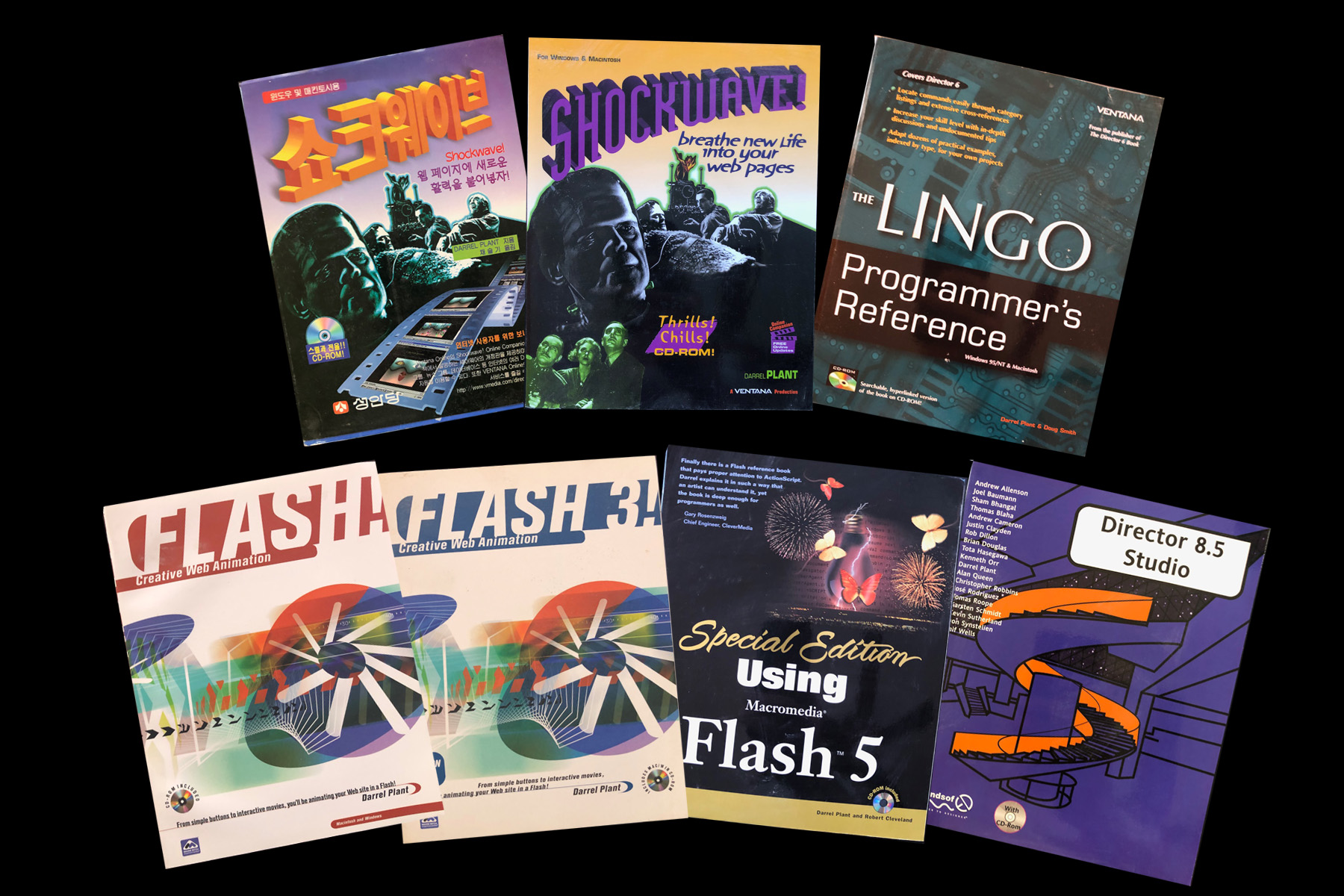
The book was done in less than ten weeks. I didn’t make it in eight. It wasn’t until it was mostly done that I suspected that Ventana had needed someone to finish a book on the roster because some other authors had dropped out or been moved to a hotter project. No, I had nothing to do with the cover (there’s a greenish Italian version around somewhere; I personally prefer the Korean cover’s colors). Back matter and the CD-ROM were produced by folks associated with Ventana; I didn’t see it until the first proofs. But my book was done.
It wasn’t a big seller, though. Plans for a follow-up fell through and my agent came back to me with an idea. Apparently, someone had liked one of the appendices I’d created, which was a structured dictionary of the network Lingo terms (NetLingo), which featured expanded usage examples of each term. Could I expand that for the entire Lingo language?
Sure, I could do that. Just give me forever and an infinite barrel of monkeys. It should have been a hard “No”, but I signed the contract and that book became the Lingo Programmer’s Reference. I got less money, it took longer (something like 700 key words in Lingo at the time), and I had to pay Doug Smith to cover for me for two weeks I took off to go to London for the first time. Then, just before the book was due to be released, Ventana announced they were being purchased, and while a number of people over the years have told me they really liked the book, I think they were all the people who bought it.
‘My’ agent came to me in early 1997, shortly after Macromedia had bought FutureSplash Animator and released version 2 as Flash. Did I want to do a quick turnaround book on Flash? He wasn’t technically representing me at that point, he was also working for Macromedia Press, but after the flop of LPR, I signed on to do what was the first official Macromedia book on Flash. That went so well that they did not hire me to update it for Flash 3, but my name’s still on the cover, so I guess it counts as my book.
It was about this point I started serving as a co-Technical Editor for a Director user’s magazine, vetting and writing articles, then working as editor for the Director Online User Group (archived by Valentin Schmidt at Das Deck) for several years, producing, editing, and writing material on Director and Flash.
Unlike a first book, I have no memory of how, Special Edition Using Macromedia Flash 5 came to me. Que hired Robert Cleveland for the graphics half of the book, I did the programming end, which was a little more complex than the earlier Flash scripting but still pre-ActionScripting. 25 years later, Pearson sends quarterly royalty statements letting me know there’s about $600 left to pay back on the advance. I made them send them by mail for as long as I could, out of spite.
Finally, the folks at friends of ED got hold of me to contribute to a sort of last gasp Director book, coming kind of at the end of the golden age of computer books and the end of Director: Director 8.5 Studio. I was one of 19 authors listed on the cover but I did three of the 18 chapters and about 100 of the 800 pages; I think I threw a little bit of a hissy fit when I got my check after seeing the completed book.
And that’s all I wrote.