The Murderous Gene. And Bob, Joe, and Albert.

It’s a shame that more people online don’t see her work, because Sharon Begley, the “Science Journal” columnist at the Wall Street Journal gets off the occasional slam at wacko theories. I was catching up on some copies of the hard edition of WSJ the other day and ran across “Theory Men Are Wired To Kill Straying Mates Is Offensive and Wrong” (and unlike some other folks, I know that you can occasionally do a Google search to find WSJ articles without registration).

In her May 20 column, Begley discusses a theory put forth in a new book on the origins of homicide by David Buss, a psychology professor at the University of Texas, Austin, entitled The Murderer Next Door: Why the Mind Is Designed to Kill. The column opens with a “Just So” story of why men “evolved” to kill mates who stray, then continues (emphasis added):

Killing, according to his [Buss’] Kipling-esque reasoning, offered so many “advantages to our early ancestors in the competition for survival and reproduction” that, today, “all men have an evolved psychology of mate killing that lies latent in their brains.” Men with the genetically based mental circuit for uxoricide had such an edge over their pacifist peers, in other words, that all men living today — their descendants — have this murder circuit, too.

For proof, Prof. Buss cites homicide statistics showing that more men than women kill, that over a five-year period in Dayton, Ohio, 52% of the women murdered were killed by a husband, lover or ex, and that women age 15 to 24 are killed by their mates or ex-mates more than over-the-reproductive-hill women are. His explanation: Only the former have evolutionary value, so men are wired to kill them if they stray but not to bother with unfaithful old bags. Also, unemployed men are more likely to kill women who dump them than are gainfully-employed men. Such low-status men, explains Prof. Buss, have the toughest time replacing their lost access to a uterus, so they’re wired to raise their attractiveness to women (“you’re so strong and powerful!”) by murdering a cheating mate.

As evolutionary theory, this is ludicrous. Killing the owner of the uterus that is your only current chance to get your genes into the next generation (the evolutionary imperative), especially if she is caring for your current children and has a father or brothers who take exception to your uxoricide, is an excellent way to a dead end personally and genealogically. Being the target of angry in-laws, not to mention life imprisonment or lethal injection, tends to limit one’s reproductive opportunities.

As a parsimonious explanation of data, the “evolution made me do it” explanation pales beside alternatives. Yes, murdered women skew young. But twenty-something men are more impulsive than fifty-something men and more likely to have a 23-year-old than a 57-year-old as a mate. And yes, unemployed men are more likely to kill or try to kill when dumped. But traits that make getting a job tough (being poorly educated, stupid, impulsive, psychotic …) can also incline a man to murder.

Keep in mind that Buss is a psychologist bending evolutionary theory to his own uses (which, presumably, could include future court testimony to support a defense of “my genes made me do it”), not a biologist explaining an adaptation.

Begley goes on to make a couple of other points against Buss’ thesis, and she deserves credit for her exposure of this incredibly stupid conjecture. However, there is one argument against the evolution of the mate-killing trait that she misses.

Successful evolutionary adaptations are usually shared by the majority of a species. Eyes, for instance, can be considered a successful trait in humans, as they are in most complex animals on earth. Most humans have eyes when they are born; those who do not or whose eyes are non-functional have difficulty leading an unassisted life. Opposable thumbs are a successful trait. Most people are born with them; some, myself included, have one or more missing or malformed thumbs. I can tell you, having two thumbs would be handy sometimes (sorry, I couldn’t resist).
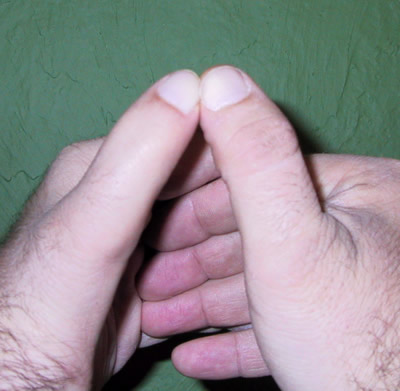
Eyes and thumbs are dominant traits in humans, murder of a mate is not. That’s not to say it doesn’t happen, but genetic defects occur all the time and they’re not treated by biologists as the norm. Buss’ treatment of evolution in this thesis is almost as confused as that of the intelligent design crowd. Rather than looking at humans in general and hypothesizing a process of evolution that reaches that point, he chooses an outlier subset of men and draws his conclusions about all men from that small sample.

Most humans will never kill another human. Most men will not kill their mates, no matter what the circumstances. Those who do are not considered acceptable to society at large in most cultures.

As Begley points out, some of the traits that make men unemployable are also linked to murderous urges. Certainly, many people are stupid, many are impulsive, many are psychotic, but even the average person fitting each of those descriptions is unlikely to commit murder. My wife’s family once had a (non-feral) cat that would lash out at anyone but my mother-in-law unprovoked, scaring another male cat of theirs twice his size, until the day he slashed my sister-in-law’s wrist so badly the tendon was exposed and they finally, tearfully, decided to put him down. That was a maladapted cat.

If evolutionary psychology wants to end up with more credibility than, say, phrenology, it must accept the same logical constrains as biological evolution. There’s no doubt that inherited physical differences in the brain can affect behavior. In all likelihood, some of the internal forces that would lead a man to murder his mate are related to differences in the makeup of his brain. That’s not the same thing as saying that mate-murder is an evolutionary adaptation of male humans in general, particularly since the act is statistically uncommon.

Perhaps Buss intends us to view those with a predilection to murder as a further evolution of the human species, like the X-Men. But it would seem to me that the numbers lie with the mass of non-murderous humanity, and that those of us who make it through our three score and ten without taking another’s life (and here I make exceptions for self-defense, public safety, combat, etc.) can consider murderers as lacking something that’s supposed to be there but isn’t quite right — sort of like my left thumb.

Share Our Wealth

On September 8, 1935—soon to be seventy years ago—Louisiana Senator Huey P. Long was assassinated in the Capitol building in Baton Rouge.

Long was a controversial figure in his day and remains so among the people who’ve heard of him. Views on his status tend to divide sharply along class lines for those who know about his history. In this first posting on Long, I’d like to let him speak for himself, from the next but last chapter in his autobiography, published the year before his death.

From Every Man a King: The Autobiography of Huey P. Long by Huey P. Long, 1933

CHAPTER XXXVI

THE MADDENED FORTUNE HOLDERS AND THEIR
INFURIATED PUBLIC PRESS!

The increasing fury with which I have been and am to be, assailed by reason of the fight and growth of support for limiting the size of fortunes can only be explained by the madness which human nature attaches to the holders of accumulated wealth.

What I have proposed is:—

THE LONG PLAN

1. A capital levy tax on the property owned by any one person of 1% of all over $1,000,000 [dp: $14,275,000 in 2005 dollars]; 2% of all over $2,000,000 [$28,550,000] etc., until, when it reaches fortunes of over $10,000,000 [$145,750,000], the government takes all above that figure; which means a limit on the size of any one man’s forture to something like $50,000,000 [$728,750,000]—the balance to go to the government to spread out in its work among all the people.

2. An inheritance tax which does not allow one man to make more than $1,000,000 [$14,275,000] in one year, exclusive of taxes, the balance to go to the United States for general work among the people.

The forgoing program means all taxes paid by the fortune holders at the top and none by the people at the bottom; the spreading of wealth among all the people and the breaking up of a system of Lords and Slaves in our economic life. It allows the millionaires to have, however, more than they can use for any luxury they can enjoy on earth. But, with such limits, all else can survive.

That the public press should regard my plan and effort as a calamity and me as a menace is no more than should be expected, gauged in the light of past events. According to Ridpath, the eminent historian:

“The ruling classes always possess the means of information and the processes by which it is distributed. The newspaper of modern times belongs to the upper man. The under man has no voice; or if, having a voice, his cry is lost like a shout in the desert. Capital, in the places of power, seizes upon the organs of public utterance, and howls the humble down the wind. Lying and misrepresentation are the natural weapons of those who maintain an existing vice and gather the usufruct of crime.”

—Ridpath’s History of the World, Page 410.

In 1932, the vote for my resolution showed possibly a half dozen other Senators back of it. It grew in the last Congress to nearly twenty Senators. Such growth through one other year will mean the success of a venture, the completion of everything I have undertaken,—the time when I can and will retire from the stress and fury of public life, maybe as my forties begin,—a contemplation so serene as to appear impossible.

That day will reflect credit on the States whose Senators took the early lead to spread the wealth of the land among all the people.

Then no tear dimmed eyes of a small child will be lifted into the saddened face of a father or mother unable to give it the necessities required by its soul and body for life; then the powerful will be rebuked in the sight of man for holding what they cannot consume, but which is craved to sustain humanity; the food of the land will feed, the raiment clothe, and the houses shelter all the people; the powerful will be elated by the well being of all, rather than through their greed.

Then those of us who have pursued that phantom of Jefferson, Jackson, Webster, Theodore Roosevelt and Bryan may hear wafted from their lips in Valhalla:

EVERY MAN A KING

Criminalizing Association at TIME

In his generally admiring review of two biographies of Robert Oppenheimer, TIME‘s Richard Lacayo makes two incredibly dense statements:

Even a generous evaluation of his fate would call him complicit in his downfall. Whether through hubris or naiveté, he refused to take seriously that his years of association with communists would open him to suspicion.

and in the very next paragraph:

Oppenheimer always denied that he had ever been a member of the Communist Party. But he never sought to conceal that he had spent much of his professional life surrounded by party members, including his younger brother Frank. Even his wife had been a member before their marriage.

Despite the best efforts of people like J. Edgar Hoover, being a member of the Communist Party or sympathizing with communists wasn’t any more of a crime than being a fascist (and it’s still not, despite TIME‘s Acc Coulter cover).

Oppenheimer had been American enough to be chosen to lead the research team in the most secret scientific pursuit of World War II. He’d helped win the war for the US, and given them a nuclear monopoly. In a sane society, that contribution would have been weighed against his “years of association with communists.” Perhaps Oppenheimer was naive about just how stupid people could be, but by any reasonable standards there should have been no “suspicion.”

And how (and why) was he supposed to hide the fact that his brother and wife had been members of the Communist Party (an organization they could legally belong to)? He never “sought to conceal” it because if you weigh the fact that they weren’t doing anything illegal against the fact that Oppenheimer built the fucking bomb, a rational person would have said “So what?”

This is another example of lazy writing, lazy editing, and lazy thought. Lacayo falls into a “blame the victim” fallacy of faulting Oppenheimer for being locked out of the nuclear research establishment while simultaneously acknowledging that the FBI illegally bugged his home, office, and phones. He mentions how Atomic Energy Commission chair Lewis Strauss used transcripts of those taps in hearings to strip Oppenheimer of his security clearance, but the guilt has already been placed on Oppenheimer by Lacayo for not taking his communist associations seriously and not trying to cover them up (and for signing farmworker rights petitions and raising funds for Republican Spain). Lacayo’s implies that Oppenheimer was pretty much asking for it, what with wearing that pretty dress and all.

Oops. I meant what with being a liberal and all.

Only a few more weeks before they stop sending me these things.

26 Years and Counting

I happened to note today that my first-ever professional publication was in April of 1979, twenty-six long years ago. I was sixteen and in high school when my good friend Jon Pitchford and I joked about making Dungeons & Dragons monsters out of the kinds of people who were the popular folks at school. I wrote up a short humorous monster description parodying the jocks and their hangers-on and sent “Narcisstics” off with high hopes to the official D&D magazine, The Dragon.

We didn’t hear anything for some time (which I expected, it wasn’t my first attempt at publication). I turned seventeen, winter turned into spring, then one day I stopped off as usual at the game shop (Gandalf’s Den in Eugene, Oregon, where I was soon working for most of the next four years), and the latest copy had our article in it. I remember racing over to Jon’s apartment at 13th & Kincaid near the UofO campus (he’d graduated from high school the previous year) with a copy of issue #24 to show him our names in print.

It took a letter to TSR (the publisher of both D&D and The Dragon) asking timorously about payment before we got our whopping $9 check. Split between the two of us, my portion just covered the cost of the two copies of the magazine I bought.

I wouldn’t get paid anything for writing again for another sixteen years, when I did an article for Step-by-Step Graphics on Oregonian graphic artist Steve Cowden.

Hunter S. Thompson

I could write something about the death of Hunter S. Thompson, just to try to fit in, but so many others have eulogized him already. Then again, I sort of did that 12 years ago when this piece appeared in issue #3 of my own Plant’s Review of Books:

Hunter and the Haunted

Hunter: the strange and savage life of Hunter S. Thompson
by E. Jean Carroll
Dutton, 1993

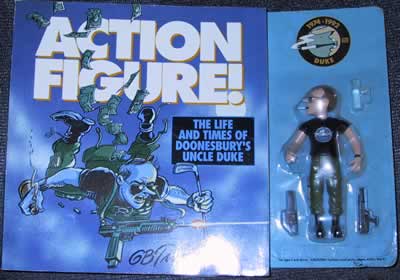
Action Figure! The Life and Times of Doonesbury’s Uncle Duke
by G.B. Trudeau
Andrews & McMeel, 1992

There’s a time in the life of every young, male, writer who’s came of age since 1970 or so, when they desire openly or secretly to be "the new Hunter S. Thompson.” The first encounter is usually a drag off of Fear and Loathing in Las Vegas, then they graduate to the harder stuff: Hell’s Angels and Fear and Loathing on the Campaign Trail ’72. Then it’s back to Las Vegas, just to get primed for that big novel they’re going to write in a marathon three-day session—bring on the amphetamines, the booze, the broads—this is the stuff Thompson’s work is made of, and the more you have, the better the book’s gonna’ be, right?

After a while, though, those young, male, writers get the picture that Thompson hasn’t really written anything since On the Campaign TrailLas Vegas included—that’s been any good or gone beyond the feeble-yet-ocassionally-punctuated-with-violence diary of a guy whose craft hasn’t gone anywhere in twenty years.

E. Jean Carroll, a frequent contributor to Esquire, has put together a schizoid biography of Thompson that, while effectively chronicling Thompson’s life through a multitude of interviews with family, friends, and associates, shows that the desire to emulate Thompson’s style is not a solely male preserve. In between some of the best-edited and well-constructed oral biography on record, Carrol chronicles the adventures of Laetitia "Tishy” Snap—a world-renowned ornithologist, who has arrived to study Thompson’s peacocks—in breathless Purple Prose:

What with the magnification of the bubbles, the underwater lights, the Jacuzzi vibrations, the heat, the steam, the marijuana, the Chartreuse and the acid, the Doctor’s doodle looked to be a half a yard long and as big around as the calf of my leg. With four or five cullions besides. "Miss Tishy,” said the Doctor, "Take off that sweater!”

What to do with a book like this, Gentle Reader?

As the liner notes, the introduction, the photos, and the text of Hunter remind us, Thompson was and has been the inspiration since 1974 for the character Uncle Duke in G.B. Trudeau’s Pulitzer-winning comic strip "Doonesbury.” Duke’s adventures in that strip have been collected into an anthology that covers his adventures as ambassador in Pago Pago and China, college-circuit speaker, Washington Redskins manager, secret agent in Iran, drug smuggler, zombie, proconsul in Panama, and bartender in Kuwait.

If the short story is allowed to stand as the exemplar of a form that requires taut, focused writing and precise dialogue, why not extend the form to include the comic?

"Okay, Springfield, if you aren’t the heat, who are you?”

"I’m from the National Rifle Association, Mr. Duke! And I was going to make you an offer…”

"The N.R.A.? Now, wait a minute, perhaps I was being a little hasty…”
"You…you know our work?”

"Know it? Hell, I’ve supported it for years! These are repressive times, Mr. Springfield!”

"And how! Even as we speak, new gun laws are being prepared by liberals and their ilk!”

"What? Liberals? Their ilk? You’ve seen them?”

"The erosion of freedom is not a pretty sight, Mr. Duke.”

And that’s merely one strip from nearly two hundred pages of three strips apiece. Setting, action, snappy dialogue. As with most of "Doonesbury” the pictures are almost incidental. A nifty five-inch figure complete with martini glass and Uzi comes bubble-packed with the book.

Where would Hunter S. Thompson would be today if it weren’t for Uncle Duke keeping his persona in the public eye on the editorial pages of hundreds of newspapers? Would he be some lonely guy on a ramshackle farm in Colorado, waiting for the royalty checks from Curse of Lono to arrive? In a perfect world, Duke would have been an unplanned collaboration between Thompson and Trudeau, with the fantasy and the fact mirroring the other. What do you do though, when the cartoon shows more life than the reality?

—Darrel A. Plant

And yes, I’ve still got both books.

Will Eisner is “The Spirit”

I spent a lot of my young adulthood around bookstores; the kind of bookstores that sold comic books and games as well as books. It was the flowering of the graphic novel, which has remained a staple of the comic industry to this day, and one of its heros was Will Eisner, whose comic “The Spirit” was seen as the touchstone of quality for storytelling and style.

According to CNN, Mr. Eisner is dead at 87, after complications from heart bypass surgery.

The National Geographic Gets Real

The National Geographic magazine has, in recent years, run its share of articles that I personally felt were pretty fluffy. Apart from articles on big cats (a kind of fluffy I enjoy), there have been many that were little more than pictorals, often with some serious fiction author expressing their thoughts in a sincere manner. Nonetheless, I’ve remained a subscriber

However, in the past three months National Geographic has run two cover articles that make up for anything that may have struck anyone as silly.

First, remember that National Geographic (the primary magazine of the Society) has an incredible circulation, somewhere around 6,000,000 copies each month in the U.S. (according to the best figures I can find), making it one of the most widely-distributed magazines in the country. They’re in homes, libraries, and schools across the nation.

In September, the cover story was “Global Warming: Bulletins from a Warmer World.” Editor Bill Allen started his letter to readers with this:

After a decade as Editor in Chief, I have a pretty good idea which articles will provoke a lot of angry letters. Whenever we publish stories that challenge widely held beliefs, some readers get mad, and they write to let us know.

Well, we’re about to do it again. We’re devoting 74 pages of this issue to a three-part series on global climate change, and I’d be willing to bet that we’ll get letters from readers who don’t believe global climate change is real, and that humans contribute to the problem. Some readers will even terminate their memberships.

The cover of November’s issue contains the provocative question: “Was Darwin Wrong?”. Eager creationist readers who flip through to page 4 will find an unequivocal answer: “No. The evidence for Evolution is overwhelming.”

Evolution by natural selection, the central concept of the life’s work of Charles Darwin, is a theory. It’s a theory about the origin of adaptation, complexity, and diversity among Earth’s living creatures. If you are skeptical by nature, unfamiliar with the terminology of science, and unaware of the overwhelming evidence, you might even be tempted to say that it’s “just” a theory. In the same sense, relativity as described by Albert Einstein is “just” a theory. The notion that Earth orbits around the sun rather than vice versa, offered by Copernicus in 1543, is a theory. Continental drift is a theory. The existence, structure, and dynamics of atoms? Atomic theory. Even electricity is a theoretical construct, involving electrons, which are tiny units of charged mass that no one has ever seen. Each of these theories is an explanation that has been confirmed to such a degree, by observation and experiment, that knowledgeable experts accept it as fact. That’s what scientists mean when they talk about a theory: not a dreamy and unreliable speculation, but an explanatory statement that fits the evidence. They embrace such an explanation confidently but provisionally—taking it as their best available view of reality, at least until some severely conflicting data or some better explanation might come along.

 
The rest of us generally agree. We plug our televisions into little wall sockets, measure a year by the length of Earth’s orbit, and in many other ways live our lives based on the trusted reality of those theories.

It’s more than likely that you’re familiar with National Geographic from your youth, if you’re not still a subscriber. In either case, it is one mass-media outlet that is willing to unapologetically state scientific fact to its readers. They deserve your support. Write a letter. Buy a copy on the newsstand (they do that now), or—better yet—subscribe. If you already subscribe, get someone a holiday gift subscription; it’s all of $19 for a year. You get beautiful pictures, some fuzzy kitty stuff, and a dose of the truth.

St. Crispin’s Day

And Crispine Crispian shall ne’re goe by,
From this day to the ending of the World,
But we in it shall be remembred;
We few, we happy few, we band of brothers:
For he to day that sheds his blood with me,
Shall be my brother: be he ne’re so vile,
This day shall gentle his Condition.
And Gentlemen in England, now a bed,
Shall thinke themselues accurst they were not here;
And hold their Manhoods cheape, whiles any speakes,
That fought with vs vpon Saint Crispines day.

    Henry V, William Shakespeare

Law & Order Fans: Ripped From “The Family”

From Kitty Kelley’s The Family: The Real Story of the Bush Dynasty, comes this tale of of long ago, when George Bush attended Andover prep school. Apart from the outsized proportion of female murderers on Law & Order — something I’ve found incredibly odd for years — here’s another reason not to watch any of the 20-odd or whatever Law & Order franchises.

Fistfights were kept to a minimum, despite the high level of teenage testosterone. “It must have been all of those hard-time athletics, plus we were convinced they put saltpeter in our food,” said Torbert Macdonald [son of a Massachussets congressman who was a good friend of President Kennedy]. “I only remember one incident of violence and that was when we got the news of President Kennedy’s assassination. I was devastated because I knew what it would do to my father. Everyone was stunned. The only guy who was insensitive and started taunting me was Dick Wolf. He never got his degree from Andover, but he managed to become a success as the executive producer of Law and Order on NBC-TV. He was a real shithead — nasty and mean — and I remember smashing my arm into his big fat gut when he started in about Kennedy minutes after the assassination.”